
Real Estate Lead Generation in Gurgaon: How Developers Get Qualified Buyer Leads in 2026
Real estate lead generation in Gurgaon for 2026: ads, content, bulk campaigns and automation, with ad budgets by ticket size from under ₹50 L to ₹20 Cr+.

Key takeaways
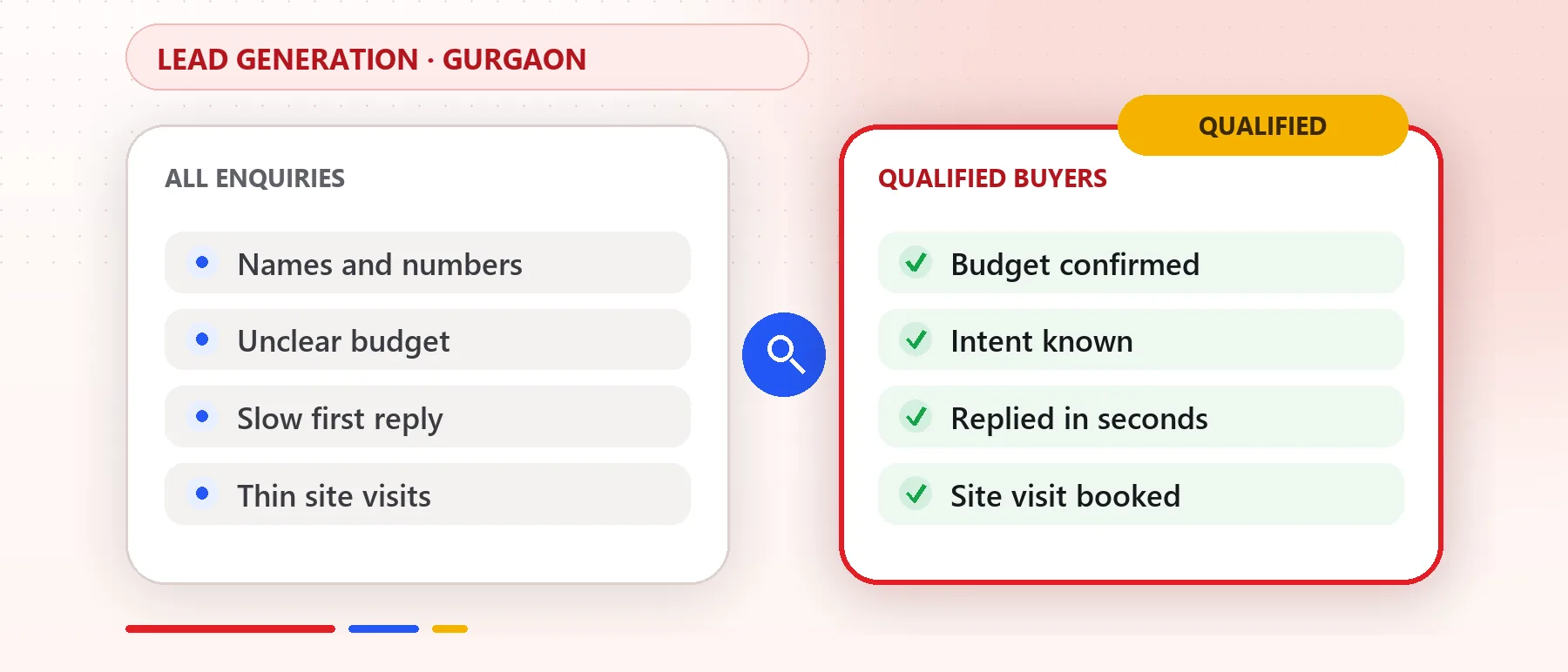
- The real question is no longer how to get leads. It is how to get qualified buyer leads to a site visit, at a cost that makes sense.
- Five things must work together: Meta and Google ads, a qualifying landing page, trust-building content, segmented bulk campaigns and automated follow-up.
- Ad budget depends on ticket size: roughly ₹1–1.3 lakh a month under ₹50 lakh, rising to about ₹5 lakh for properties above ₹20 Cr.
- Measure the funnel, not just CPL: cost per qualified lead, speed to first response, site visits and cost per site visit.
Prices in Gurgaon keep rising. Launches keep arriving. And yet many developers tell the same story: plenty of enquiries, thin site-visit numbers, and a sales team that has stopped believing the lead sheet.
The real question is no longer how to get leads.
The real question for real estate lead generation in Gurgaon is how to get qualified buyer leads to a site visit, at a cost that makes sense, in a market where every serious project is competing for the same attention.
Quick answer
To get qualified buyer leads in Gurgaon in 2026, developers need five things working together: Meta and Google ads aimed at defined buyer segments, a landing page that asks qualification questions, content that builds trust, segmented bulk campaigns to warm and old leads, and automated follow-up that replies in seconds. The ad budget you need depends on ticket size, from roughly ₹1–1.3 lakh a month for inventory under ₹50 lakh to around ₹5 lakh for properties above ₹20 Cr.
In this guide. Tap a section to jump straight to it.
The Gurgaon real estate market in 2026: why lead generation got harder
Gurgaon is still the engine of NCR real estate, but conditions have shifted.
- Prices are climbing while volumes soften. ANAROCK’s April–June 2026 data, as reported by The Tribune, shows NCR prices up about 13% year on year while NCR home sales fell about 6%. The report attributes much of the price rise to premium Gurgaon corridors: Dwarka Expressway, the Southern Peripheral Road (SPR) and Golf Course Extension Road.
- The luxury map is widening. Outlook Money, citing Magicbricks, reports Dwarka Expressway apartments averaging ₹14,661 per sq ft in Q2 2026, up from ₹12,525 in 2024. New Gurugram, Sohna and Golf Course Extension Road are also growing as premium corridors.
- The launch pipeline is crowded. Business Today reported roughly ₹35,000 crore of luxury launches planned on Golf Course Extension Road alone.
What this means for you: buyers see more options, take longer to decide, and compare more carefully. A buyer investing ₹3–10 crore or more will not respond to a generic “Book Now” ad. They want proof, clarity and a reason to pick your project.
What is a qualified buyer lead?
A lead is a name and number. A qualified lead has told you enough to prove they might buy.
At GBM, we treat a lead as qualified once the person has completed a short set of qualification questions, typically five to eight, covering budget, preferred size, purpose (end-use or investment), timeline, location and willingness to visit. Serious buyers self-select, and your sales team starts every call with context.
Everything below is built around producing and protecting qualified leads, not just more of them. If most of your leads still feel like junk, start with our guide to fixing junk leads from Meta and Google.
Step 1: Define your Gurgaon buyer segments
“Gurgaon buyers” are not one audience. Before you spend a rupee, define who the project is for:
- Upgraders and CXOs moving within NCR, who care about schools, commute and community.
- Investors who think in appreciation and rental yield.
- NRI buyers, who need trust, clarity on paperwork and remote-friendly buying steps.
- End-users in value corridors such as New Gurugram or Sohna, who watch EMI and possession dates closely.
Each group responds to different messages, creatives and follow-up. A project on Golf Course Extension Road, one on Dwarka Expressway and one in Sohna should not run the same ad.
Step 2: Run Meta and Google ads for Gurgaon real estate
Paid ads are the fastest way to reach buyers at scale. They only work when each platform has a clear job.
Creates demand
Facebook and Instagram
- Reaches people before they start searching.
- Roughly ₹200–400 CPL at ₹2 Cr, about ₹800 at ₹5 Cr, ₹1,500–2,000 at ₹10 Cr and above.
- Closures typically need about 100–150 leads.
Captures demand
Search
- Appears when someone is already searching.
- CPL is typically almost double, and the same budget buys fewer leads.
- Closures often come after roughly 20–50 leads.
In our experience, Meta builds a pool of future and impulsive buyers, if you follow up well. These are indicative figures from our campaigns, not guarantees. They vary by project, creative, audience and sales process. For the full Google playbook, read Google Ads for Real Estate in Gurgaon.
Make the landing page do the filtering. Send ad clicks to a page that shows the project honestly (price range, configuration, location) and asks the qualification questions. You will pay more per lead, but far fewer calls will be wasted.
Keep ads compliant. Projects generally need to be registered under RERA before they are advertised, and registration details should appear in your ads. Haryana’s regulator has warned buyers about unregistered projects. Confirm current HRERA advertising rules with your legal team before launching creatives.
Step 3: Content marketing for real estate developers: build trust before the first call
Ads get attention. Content earns belief. For high-ticket property, belief decides whether a buyer takes your call or ignores it.
Content that works for Gurgaon developers:
- Micro-market guides. “Living on Dwarka Expressway: commute, schools and what to expect” ranks on Google and answers real questions. Write one for every corridor you sell in.
- Project explainers. Layouts, specifications, payment plans and timelines in plain language.
- Founder and consultant-led video. A senior person answering buyers’ doubts builds more trust than a polished brochure.
- Construction and delivery updates. Proof of progress is one of the strongest trust signals for under-construction projects.
- Buyer-doubt content. RERA, possession, resale, rental yield, loan process. Answer what buyers are afraid to ask.
How much content does it take? In our experience, content-led demand for properties from about ₹30 lakh to ₹30 Cr takes somewhere between roughly 30 and 500 pieces of content, distributed across different channels, to support 10–20 sales or deals.
Think of about 30 as a lean, focused start on one project and a few channels, and 500 as a full multi-channel programme. A “piece” can be a reel, video, carousel, blog article, post, email or ad creative.
Distribution matters as much as volume. Turn one site visit or one buyer question into several pieces and publish them across YouTube, Instagram, Facebook, LinkedIn, Google Business Profile, your blog and WhatsApp. These are indicative figures, not promises. They vary with ticket size, competition and how well the content is distributed.
Why this matters for lead generation. Good content lowers your cost per qualified lead, because buyers arrive better informed. It also improves SEO over time, so you receive enquiries you didn’t pay for. Use AI to draft and repurpose faster, but keep a human editor responsible for accuracy, compliance and tone.
Step 4: Bulk campaigns for real estate: WhatsApp, SMS and email done right
Bulk campaigning is where many developers either win big or burn their database. Done well, it turns an existing list into site visits. Done badly, it gets numbers blocked and your brand ignored.
Where bulk campaigns shine:
- Launch announcements to your registered interest list.
- Site-visit events and weekend open-house invitations.
- Price or scheme updates to buyers who have already shown interest.
- Festive-season offers for warm leads.
- Reactivating old leads from past campaigns that never converted.
How to do it properly:
- Segment first. Don’t send the same message to a ₹2 Cr investor and a ₹10 Cr NRI. Group by budget, location, stage and past behaviour.
- Use the right channel. WhatsApp for conversation, email for detail, SMS for short reminders. Voice or IVR calls can work for event reminders.
- Get consent. WhatsApp Business requires opt-in and approved message templates. SMS and calls in India fall under TRAI rules, including registration and DND preferences. India’s data protection law also affects how you store and use personal data. Check current requirements with your legal advisor.
- Keep frequency low. Two or three well-timed messages a week beat daily blasts.
- Give people a way out. An easy opt-out protects your sender reputation.
- Measure replies, not sends. Track delivery, reads, replies and site visits booked.
A bulk campaign is a nurturing tool. It is not a substitute for ads or content, and it is only as good as the list behind it.
Step 5: Automate real estate lead follow-up so no qualified lead goes cold
This is where most lead generation quietly fails. Buyers enquire on several projects at once, and the first useful reply often wins the conversation.
A good automated follow-up system includes:
- An instant WhatsApp reply that mentions the project the buyer asked about.
- Conversational qualification, so serious buyers are identified quickly.
- A prompt to book a site visit or call, with real time slots.
- Reminders before the visit, plus a rescheduling option.
- A long nurture sequence for buyers who aren’t ready, with project updates and useful content.
- A clean handover to a human when the buyer wants to discuss price, negotiate or visit.
AI helps by answering common questions at any hour, scoring leads from their answers and summarising conversations for your sales team. It should support your team, not replace the human conversation at the stage where a buyer wants a person. See how our RDA™ system connects ads, follow-up and content.
Step 6: Work your channel partners and your own database
Many Gurgaon developers rely on channel partners (CPs) for volume. They can be a strong source of qualified buyers, but only if you manage them:
- Give CPs clear project information, pricing and approved creatives, so they don’t improvise claims.
- Track which CP brought which lead, and which actually closed.
- Respond quickly to CP leads, since CPs share leads across developers.
Also revisit your own database. Past enquirers who didn’t buy are often cheaper to convert than new leads. A segmented nurture sequence or bulk campaign can bring many of them back.
Step 7: Measure what predicts bookings, not just cost per lead
Cost per lead is a weak yardstick on its own. Track the funnel instead:
| Metric | Why it matters |
|---|---|
| Cost per qualified lead | The first honest cost number |
| Qualified-lead ratio | Shows whether the right people are finishing the form |
| Speed to first response | Slow replies lose buyers |
| Site visits booked and completed | The real marketing outcome |
| Cost per site visit | Ties spend to a real event |
| Lead-to-closure ratio | The final test, over months |
Review the early metrics weekly and the closure metrics quarterly. We explain why in Why CPL Is the Wrong Metric in Real Estate Marketing.
How much ad budget do you need? It depends on ticket size
A ₹40 lakh flat and a ₹15 Cr home have different buyers, different CPLs and different sales cycles, so one budget number never fits. In our experience, this is the monthly ad budget typically needed to aim at the closures shown:
| Property ticket size | Closures to aim for | Typical monthly ad budget |
|---|---|---|
| Under ₹50 lakh | 5–10 | ₹1–1.3 lakh |
| ₹50 lakh–₹1 Cr | 3–4 | About ₹1.5 lakh |
| ₹1–2.5 Cr | 2–3 | ₹1.5–2 lakh |
| ₹2.5–5 Cr | 1–2 | ₹1.5–2 lakh |
| ₹5–10 Cr | 1–2 | ₹2–3 lakh |
| ₹10–20 Cr | 1–2 | ₹3–4 lakh |
| ₹20 Cr and above | 1–2 | About ₹5 lakh |
Read the table with care:
- These are ad budgets, paid to Meta and Google. Agency fees are separate.
- They are indicative, not guarantees. Closures depend on pricing, inventory, the site experience and your sales team’s follow-up.
- Lower ticket sizes close more often, so the same budget aims at more deals. Higher ticket sizes need fewer closures to justify the spend, but longer cycles and more patience.
A 90-day plan for a Gurgaon launch
| Phase | Focus | Key actions |
|---|---|---|
| Days 1–30 | Foundation | Define buyer segments, build the qualification landing page, set up tracking and WhatsApp automation, publish first micro-market and project content |
| Days 31–60 | Scale | Launch Meta and Google campaigns, test creatives, start founder-led video, run the first segmented bulk campaign to interested leads |
| Days 61–90 | Convert | Push site-visit events, reactivate older leads, refine qualification from sales feedback, shift budget toward what produces visits |
Common mistakes developers make
- Chasing the cheapest lead. Low CPL often means low intent.
- Running one ad for every buyer. Segments need different messages.
- Slow follow-up. Hours of delay quietly waste ad budget.
- Blasting the whole database. Unsegmented bulk messages damage trust and sender reputation.
- Ignoring compliance. RERA, messaging and data rules exist for good reason.
- Skipping content. Without trust-building content, every lead costs more to convert.
- Judging too early. Closures take time. Judge early signals weekly and revenue monthly or quarterly.
FAQ
How do developers get qualified buyer leads in Gurgaon?
By combining targeted Meta and Google ads, a landing page that asks qualification questions, trust-building content, fast automated follow-up and segmented nurture campaigns, then measuring site visits, not just leads.
What is the average cost per lead for real estate in Gurgaon?
It varies with price band, platform and lead quality. In our experience, Meta CPL in India is around ₹200–400 for ₹2 Cr inventory, about ₹800 for ₹5 Cr and ₹1,500–2,000 for ₹10 Cr and above. Google is typically almost double. These are indicative ranges, not guarantees.
How much should a developer spend on ads to get bookings in Gurgaon?
It depends on ticket size. In our experience, roughly ₹1–1.3 lakh a month for inventory under ₹50 lakh, ₹1.5–2 lakh for ₹1–5 Cr, ₹2–3 lakh for ₹5–10 Cr, ₹3–4 lakh for ₹10–20 Cr and about ₹5 lakh above ₹20 Cr. These are ad budgets, excluding agency fees, and not guarantees.
How much content does a real estate project need?
In our experience, roughly 30 to 500 pieces of content across different channels support 10–20 sales or deals for properties between about ₹30 lakh and ₹30 Cr. The number depends on ticket size, competition and distribution.
Is bulk WhatsApp or SMS marketing allowed for real estate in India?
It can be used, but only with consent, approved templates and compliance with messaging and data rules. Check current WhatsApp, TRAI and data-protection requirements with your legal advisor before running campaigns.
Is Meta or Google better for Gurgaon real estate?
Neither is better everywhere. Google captures buyers already searching and closes in fewer leads but costs more per lead. Meta delivers more leads at lower CPL and builds a pipeline of future buyers, but needs more leads per closure and good follow-up. Many developers use both.
Sources
- The Tribune: Gurugram drives NCR price surge even as home sales dip, new launches slow
- Outlook Money: Gurugram’s luxury housing map expands beyond established strongholds
- Business Today: Golf Course Extension Road gets Rs 35,000 crore luxury housing push
If you want a stronger system behind your marketing
If you have a budget of ₹50,000 to ₹1.5 lakh a month for an agency, and you want a premium team that works on ads, AI follow-up and content together, connect with Grand Business Media. We work with realtors and developers who want clear process and honest reporting.
More from the GBM blog
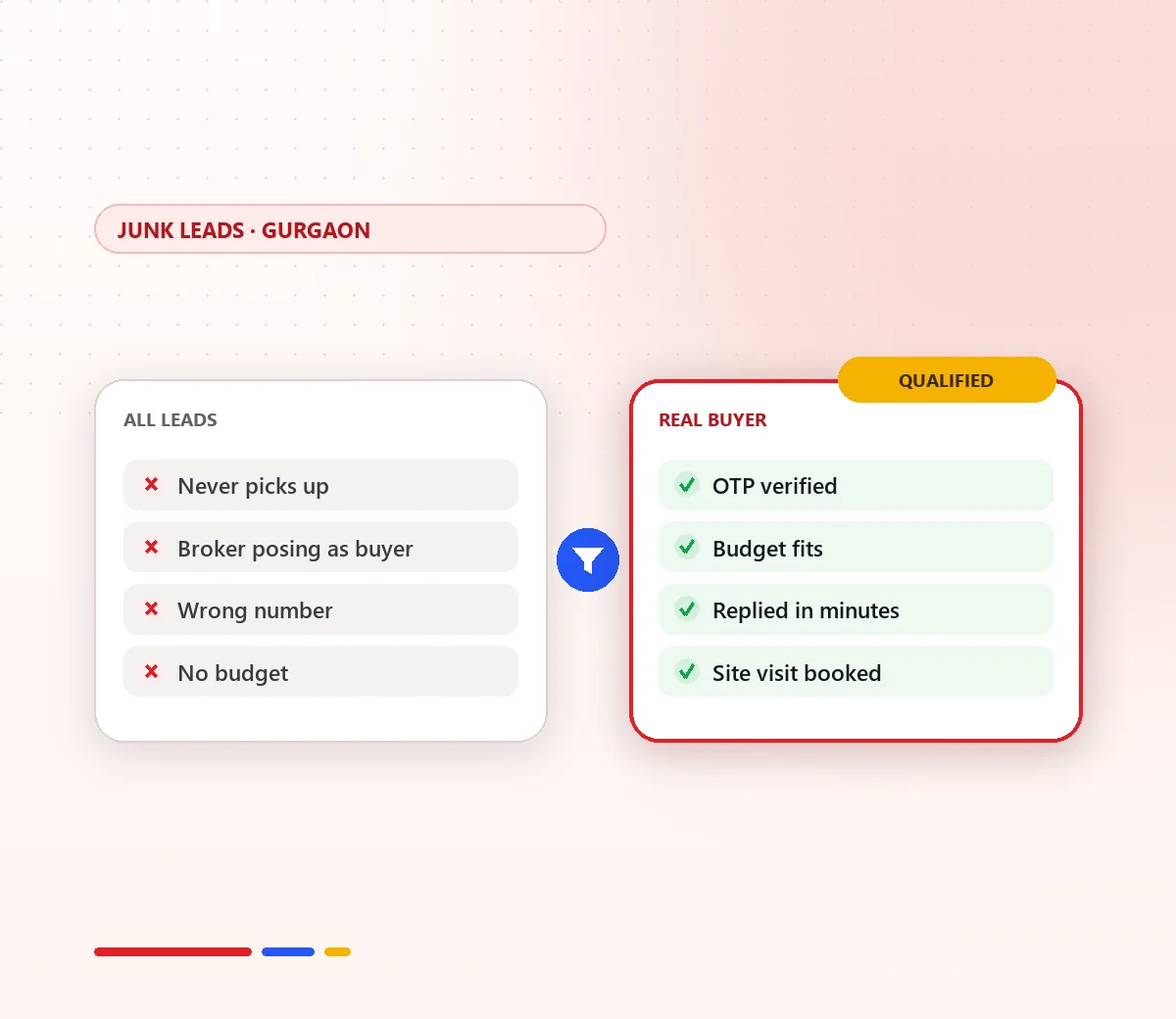
Why Your Real Estate Ads Bring Junk Leads in Gurgaon, and How to Fix Meta and Google Campaigns
Why Gurgaon developers get junk leads from Meta and Google ads, and the fixes: fast response, 100-touch follow-up, Meta targeting, retargeting, Google setup and tracking.
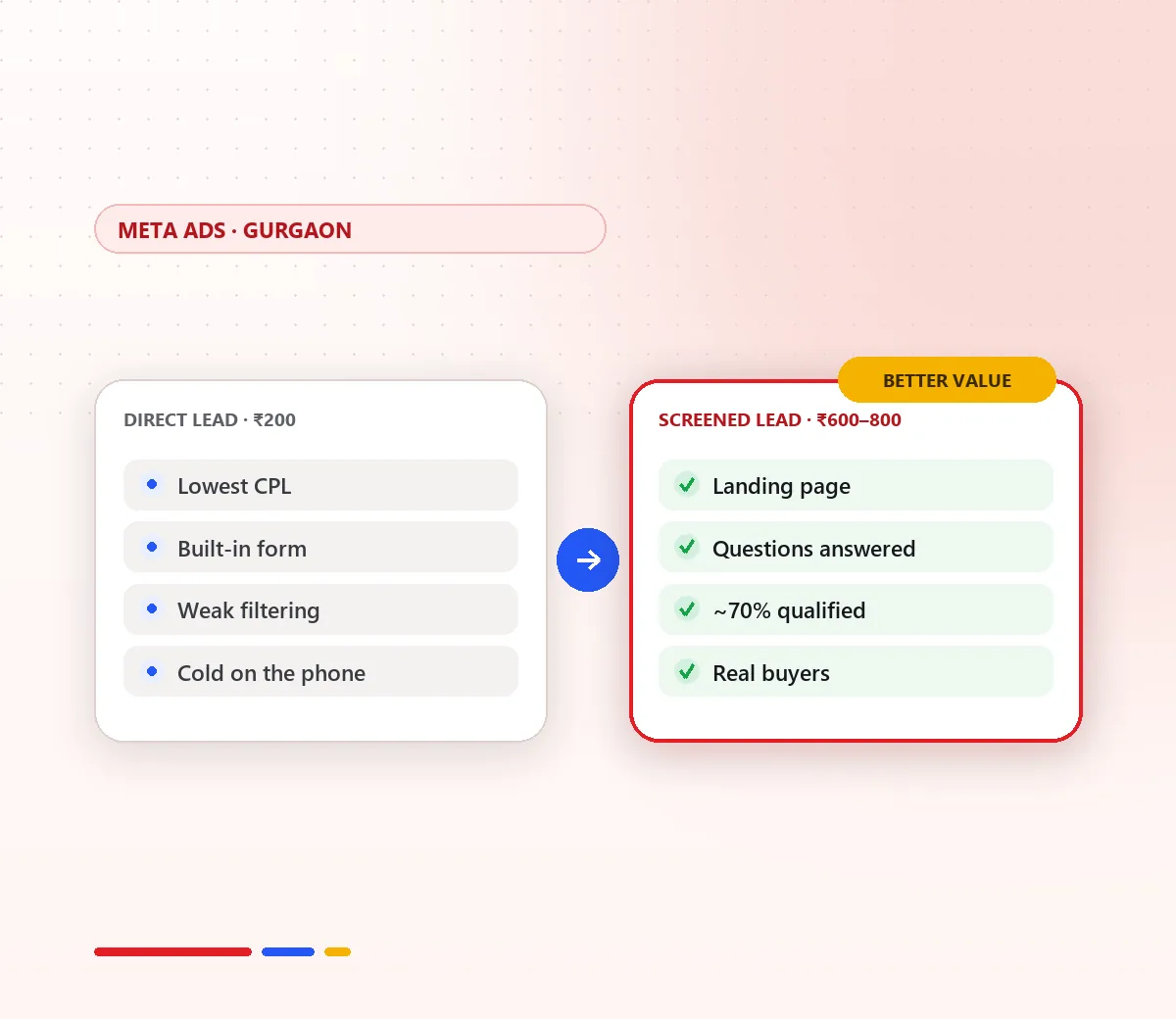
Meta Ads for Real Estate Developers in Gurgaon: How to Lower CPL and Get Qualified Leads
How Gurgaon developers lower Meta ads CPL without losing lead quality: audience cost, landing pages, lookalikes, creative, tracking and budgets by ticket size.
Reading is step one. Let’s build your buyer pipeline.
Book a free 30-minute strategy session and we’ll map exactly how these systems would work for your projects.
Gurgaon · Dubai · Limited client seats each year