
Why CPL Is the Wrong Metric in Real Estate Marketing, and What to Track Instead
Cost per lead misleads real estate marketers. See why, which metrics predict bookings, how Meta and Google really compare, and what budget closures need.

Key takeaways
- CPL tells you what a contact costs, not whether that contact is a buyer. Judge campaigns on cost per qualified lead, cost per site visit and cost per closure.
- A higher CPL can be the better deal. On a ₹5 Cr property, Google’s leads cost about double Meta’s but can cost less per closure.
- Compare CPL only within the same price band and platform. A ₹200 lead and a ₹1,800 lead belong to different markets.
- Plan roughly ₹2–3 lakh a month in India, or AED 10,000–15,000 in Dubai, before you expect closures. Smaller budgets give you luck, not data.
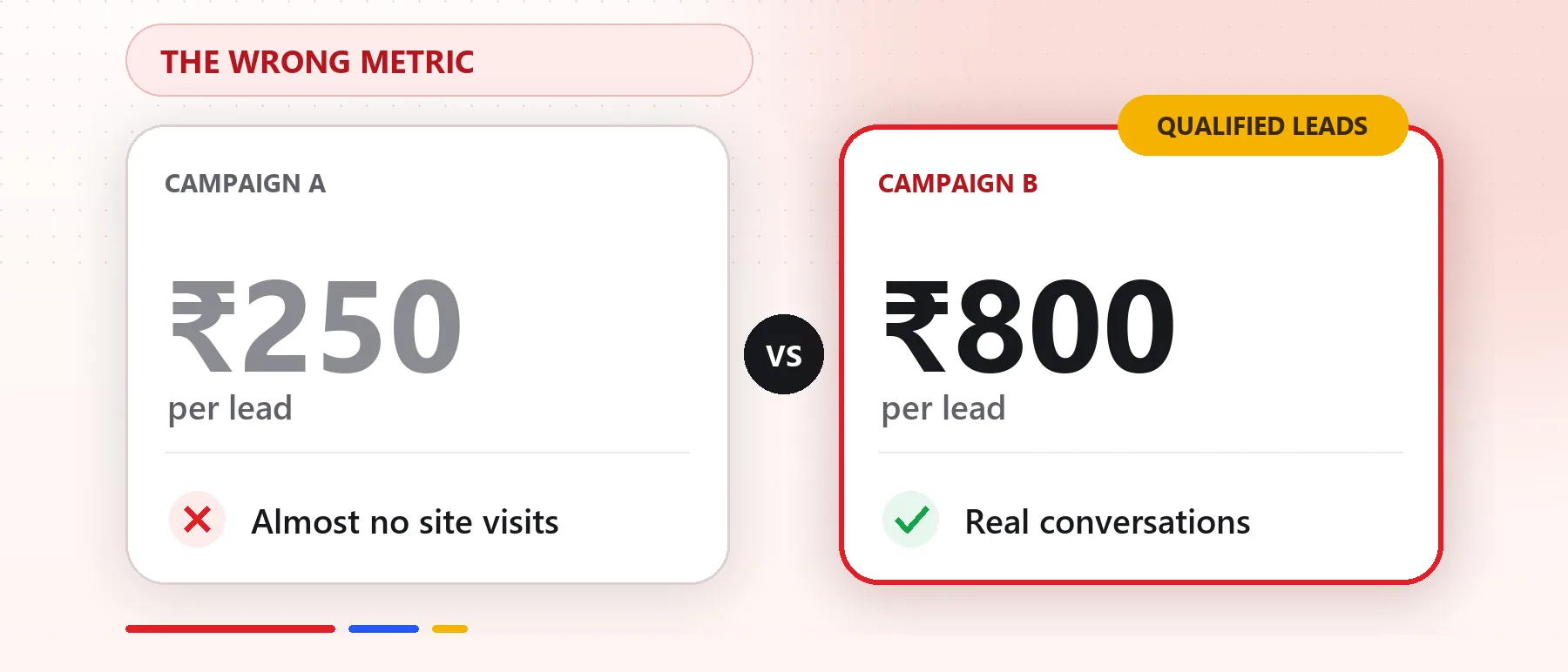
Two campaigns. Same budget. Same project.
The report glows green. Hundreds of leads, almost nobody who will visit.
The agency apologises for the “high” cost. Fewer people, real conversations.
Three weeks later, your sales team has made hundreds of calls on Campaign A and found almost nobody who will visit the site. Campaign B sent fewer people, but half of them have already answered your qualification questions, and the calls feel like conversations.
Which campaign was actually cheaper?
If you judge by cost per lead (CPL), you will pick the wrong one. This guide explains why cost per lead in real estate misleads, which metrics predict bookings, how Meta and Google really compare, and what budget you need before you can expect closures.
CPL tells you what a contact costs. It says nothing about whether that contact is a buyer, whether your team can reach them, or whether they will ever visit the site. Better metrics follow the buyer through the funnel: cost per qualified lead, site-visit rate, cost per site visit, and cost per closure.
Why CPL fails in real estate
- A lead is not a buyer. A form fill takes seconds. A property purchase takes months, a family discussion and a large decision. CPL treats both as the same unit.
- CPL rewards the wrong behaviour. The cheapest way to lower CPL is to make the form easier, the offer broader and the audience wider. That brings volume and curiosity, not buyers. An agency chasing CPL can improve its number while your results get worse.
- CPL ignores your sales team’s time. Every dead call has a cost: salary, patience, and the chance that a real buyer waited in the queue. A cheap lead that wastes forty minutes is expensive.
- CPL changes enormously with price. You can’t compare a ₹200 lead for a ₹1.5 Cr flat with a ₹1,800 lead for a ₹15 Cr home. They are different markets with different buyers.
What a lead really costs: it depends on the price band
From GBM’s campaign experience, here is how Meta CPL typically moves with property value in India. These are indicative ranges, not guarantees. Real CPL depends on the project, creative, audience, competition and how strictly you define a lead.
| Property value | Typical Meta CPL (India) |
|---|---|
| Around ₹2 Cr | ₹200–₹400 |
| Around ₹5 Cr | About ₹800 |
| ₹10 Cr and above, up to ₹20 Cr and premium Dubai/Arabian-market campaigns | ₹1,500–₹2,000 |
On Google, expect CPL to be roughly double, and the budget needed to be roughly double as well. Google reaches people already searching, and those clicks cost more.
For UAE (Dubai) property, cost per lead also depends heavily on where the buyer lives:
- Buyers in India: about ₹600–₹1,000+ (roughly ₹600–900 for AED 1M properties and ₹900–1,000 for AED 3M).
- Buyers already in the UAE: about AED 60–110.
- NRI buyers in Canada, the UK or Australia: typically ₹2,000–₹3,500 on Meta, sometimes reaching ₹4,000. On Google, it can climb to ₹4,000–₹5,000.
Overseas audiences are smaller, costlier to reach and slower to decide. That makes qualification and follow-up matter even more, because every wasted lead costs several times what it would in India.
The point is not to memorise a number. The point is that a “good” CPL only means something when compared against price band, platform and lead quality.
What counts as a qualified lead?
At GBM, a qualified lead is a person who has completed our qualification questions. Typically five to eight short questions, such as:
- Budget range
- Preferred size or configuration
- Purpose: end-use or investment
- Buying timeline
- Location or city
- Willingness to visit or take a call
That definition does two useful things. First, it filters out casual taps, because people who finish a questionnaire have shown effort. Second, it hands your sales team context before the first call. They are not starting from a name and a number.
A completed form is not a guaranteed buyer, so the answers matter too. Use them to score leads: a buyer whose budget matches the project and who wants to visit within a month deserves a call today.
The metrics that matter instead
Think of these as a ladder. Each step is closer to revenue than the one before.
- Cost per qualified leadWeekly
Total ad spend divided by leads who completed qualification. It is the first honest number. Compare it, not raw CPL, across campaigns.
- Qualified-lead ratioWeekly
The share of leads who complete qualification. A low ratio means your ads attract the wrong people or your form creates friction in the wrong place.
- Speed to first responseWeekly
How long from enquiry to the first meaningful reply. Automation can answer in seconds. If your average is hours, quality leads cool before anyone speaks to them.
- Contact rateWeekly
The share of leads your team actually talks to. If calls go unanswered, check timing, number masking and whether the follow-up is only calls instead of WhatsApp.
- Site-visit booking rateMonthly
The share of qualified leads who agree to visit. It tells you whether your sales conversation and offer are convincing.
- Show-up rateMonthly
The share of booked visits that actually happen. Reminders, confirmation messages and clear location details move this number more than most teams expect.
- Cost per site visitMonthly
Ad spend divided by completed visits. For many projects, this is the most useful marketing number because it ties spend to a real event.
- Lead-to-closure ratio and cost per closureQuarterly
The ultimate measure, but slow and noisy, because closures depend on pricing, inventory and your sales team as well as marketing. Track it over quarters, not weeks.
A simple rule: the closer a metric is to a booking, the more it matters, and the longer it takes to measure. Use the early metrics (1–4) to steer the campaign each week, and the later ones (5–8) to judge it each month.
If you want to see how a stage-by-stage view looks in practice, our 30-minute agency audit shows how to check these numbers in your own accounts, and our agency pricing guide explains how fees and ad spend should be separated.
Meta vs Google: different CPLs, different closure rates
Here is where CPL alone really misleads. From GBM’s experience, the platforms behave differently.
About 100–150 leads per closure
Facebook and Instagram
- Reaches people before they start searching, so more leads are needed.
- The audience is far larger and CPL is lower.
Roughly 20–50 leads per closure
Search
- Sometimes 20, sometimes 30, sometimes 50.
- Buyers are searching with intent, so fewer leads are needed.
These are indicative patterns from our campaigns, not promises. Your result depends on the project, price, creative and sales process.
Let’s see what that means for a ₹5 Cr property, using the CPL figures above (Meta about ₹800, Google about double, so ₹1,600). This is simple average arithmetic, not a forecast:
| Platform | CPL | Leads per closure | Ad spend per closure (average) |
|---|---|---|---|
| Meta | ~₹800 | 100–150 | ~₹80,000–₹1,20,000 |
| ~₹1,600 | 20–50 | ~₹32,000–₹80,000 |
On paper, Google looks cheaper per closure even though its CPL is double. That is the whole lesson: a higher CPL can be the better deal.
But the table hides a trade-off. At the same budget, Google gives you far fewer leads, because each click costs more and searches for your project and locality are limited. Fewer leads means a lumpier, less predictable pipeline. A single missed call matters more.
Try it with your own numbers
Change the two inputs below to see what one closure costs you in ad spend. Start with the presets, then use your own CPL and your own leads-per-closure history.
This is average ad spend only. Your agency fee, creative cost and sales team time are on top.
Meta’s hidden advantage: the future buyer
Meta’s strength does not show up in the closure ratio. It shows up in what happens to the leads who don’t buy this month.
Meta reaches people who weren’t searching yet. Some are not ready now, but they become buyers in three, six or twelve months. Others are impulsive buyers who respond to a strong creative at the right moment. If you treat those leads properly, tuning your qualification, automating the follow-up and using AI to keep conversations alive, Meta becomes a source of future buyers, not just this month’s leads.
That depends on three things:
- Automation: instant replies, reminders, and a long nurture sequence so no lead is forgotten.
- AI: screening enquiries, answering common questions at any hour and handing over to a human when a buyer is ready to talk.
- Content: project explainers, buyer-doubt videos and consultant-led reels that keep your brand in front of a buyer who isn’t ready yet.
An agency that stops at “leads delivered” leaves this value on the table. This is why the follow-up system deserves as much attention as the ad. See how real estate automation keeps every lead warm.
How much budget do you need to expect closures?
Here is the honest part. Closing property is a game of probability. You need enough leads flowing for the average to play out.
₹2–3 lakh a month
Realistic chance of 1 to 3 closures
- Below that, the sample is too small.
- A single month can look bad from luck, not strategy.
AED 10,000–15,000 a month
To aim at 1 or 2 deals
- Depends on property price, from AED 1M to 10M.
- Higher prices mean fewer, longer sales, so budget and patience must rise.
Two caveats matter. First, these are budgets for ad spend. Your agency fee is separate. Second, they describe an opportunity, not a guarantee. A good campaign raises your odds, but your pricing, inventory, site-visit experience and sales team decide how many conversations end in a booking.
A simple weekly dashboard
You don’t need twenty charts. Track these every week and review them with your agency:
| Metric | What to ask | Warning sign |
|---|---|---|
| Cost per qualified lead | Is it stable or rising? | Rising without a change in your offer |
| Qualified-lead ratio | Are the right people finishing the form? | Sudden drop after a creative change |
| Speed to first response | How fast is the first reply? | Hours instead of seconds |
| Contact rate | Are we reaching them? | Many unanswered calls |
| Site visits booked / done | Are people turning up? | Many bookings, few visits |
| Cost per site visit | What does a visit cost us? | Climbing steadily |
| Closures this month | How many bookings? | Zero for several months |
Common mistakes when moving beyond CPL
- Replacing one vanity metric with another. Qualified leads are better, but they still aren’t bookings. Keep the whole ladder in view.
- Judging a campaign too early. Closures are slow. Judge early metrics weekly and revenue metrics quarterly.
- Comparing across price bands. A ₹200 lead for a ₹2 Cr flat and a ₹1,800 lead for a ₹15 Cr home are not comparable.
- Blaming the ads for everything. If qualified leads are good but site visits are low, the problem may be follow-up, pricing or the sales conversation.
- Ignoring older leads. Many buyers come back months later. Keep them in a nurture sequence.
FAQ
What is a good cost per lead in real estate?
It depends on the price band, platform and lead quality. As a rough guide, Meta CPL in India may be around ₹200–400 for a ₹2 Cr property and ₹1,500–2,000 for ₹10 Cr and above. For UAE projects targeted at NRIs in Canada, the UK or Australia, Meta CPL is typically ₹2,000–3,500 and can reach ₹4,000, while Google can reach ₹4,000–5,000. A "good" CPL is one that produces qualified leads and site visits at a sensible cost.
Is cost per lead completely useless?
No. It is a useful early signal for creative and audience performance. It is just a poor way to judge an agency or a campaign on its own.
Is Google better than Meta for real estate?
Neither is better everywhere. Google captures buyers already searching and tends to close in fewer leads, but costs more per lead and delivers less volume. Meta delivers more leads at lower CPL and builds a pipeline of future buyers, but needs more leads per closure and good follow-up.
How many leads does it take to close a property deal?
In GBM’s experience, roughly 20 to 50 leads on Google and 100 to 150 on Meta. These are indicative, not guaranteed, and vary by project and sales process.
How much should I spend on ads to get a booking?
In India, planning around ₹2–3 lakh a month gives a realistic chance of 1 to 3 closures. In Dubai, around AED 10,000–15,000 a month for 1 or 2 deals, depending on price.
If you want a stronger system behind your marketing
If you have a budget of ₹50,000 to ₹1.5 lakh a month for an agency, and you want a premium team that works on ads, AI follow-up and content together, connect with Grand Business Media. We work with realtors and developers who want clear process and honest reporting.
More from the GBM blog
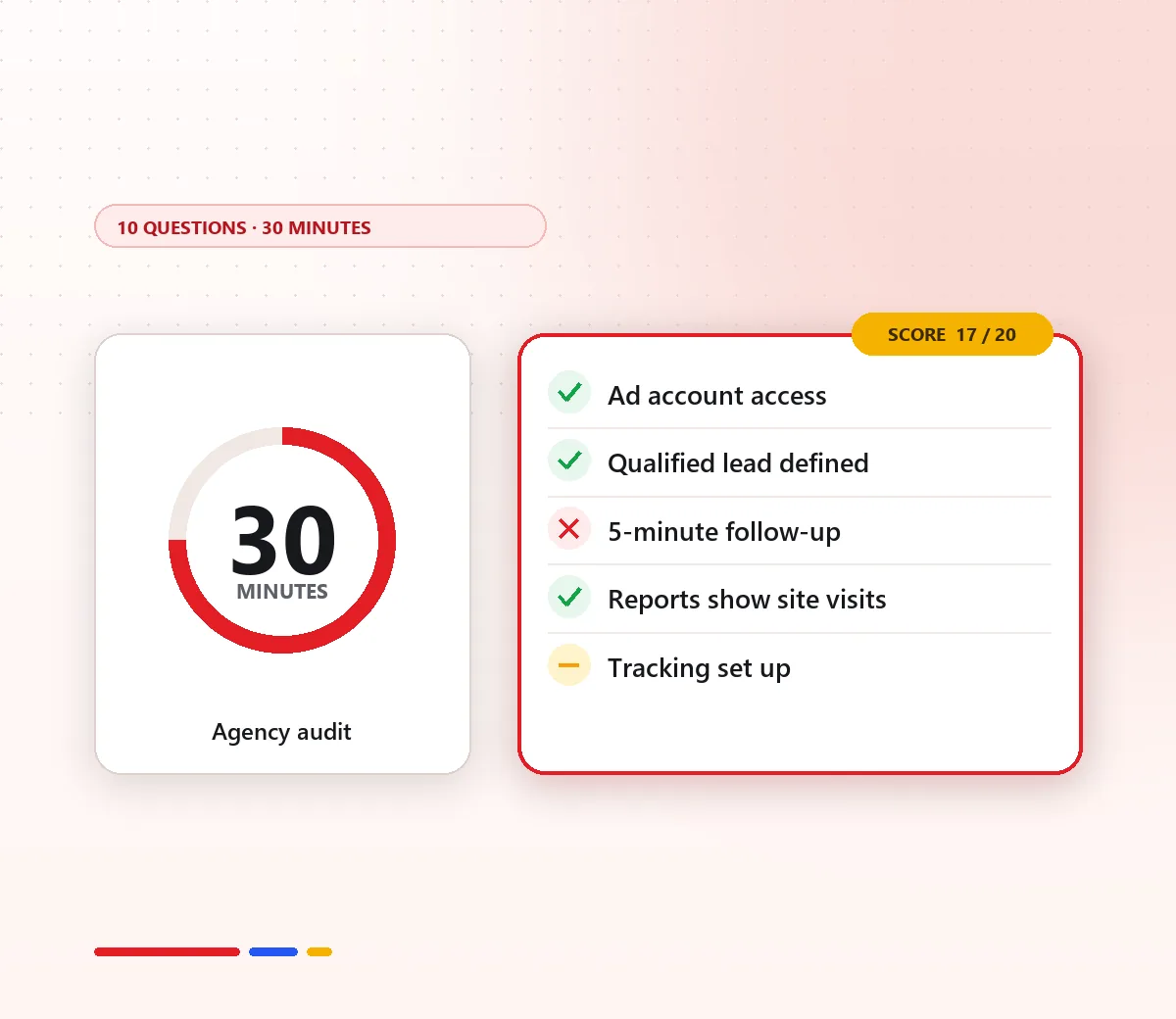
How to Audit Your Real Estate Marketing Agency in 30 Minutes: 10 Questions to Ask
Is your real estate marketing agency working? Audit Meta and Google campaigns, AI follow-up, content and reporting in 30 minutes with these 10 questions.
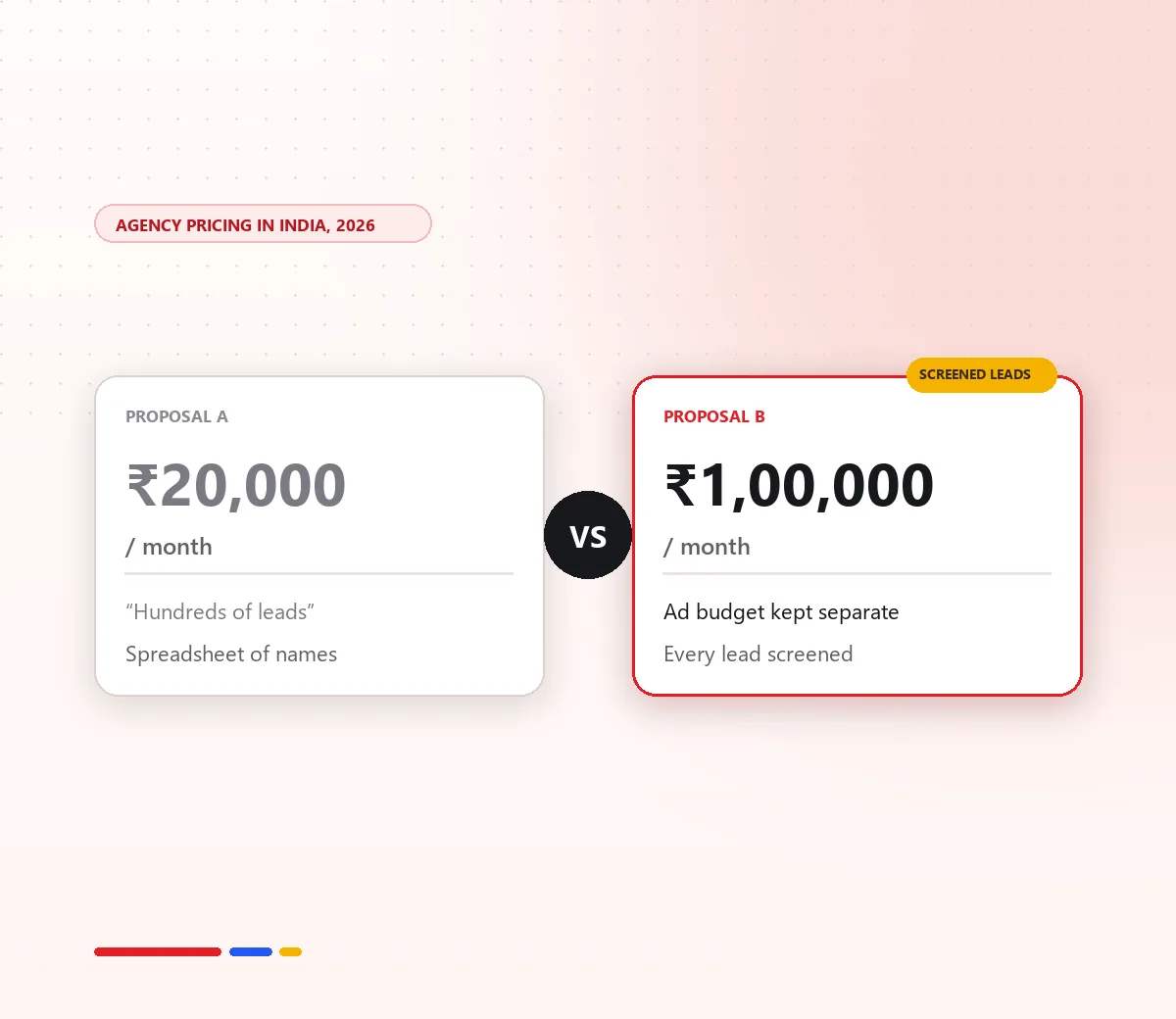
How Much Does a Real Estate Marketing Agency Cost in India? Retainer vs Performance Pricing
Real estate marketing agency pricing in India: retainer vs performance models, real lead costs, minimum ad spend and the maths most agencies hide.
Reading is step one. Let’s build your buyer pipeline.
Book a free 30-minute strategy session and we’ll map exactly how these systems would work for your projects.
Gurgaon · Dubai · Limited client seats each year