
How to Audit Your Real Estate Marketing Agency in 30 Minutes: 10 Questions to Ask
Is your real estate marketing agency working? Audit Meta and Google campaigns, AI follow-up, content and reporting in 30 minutes with these 10 questions.

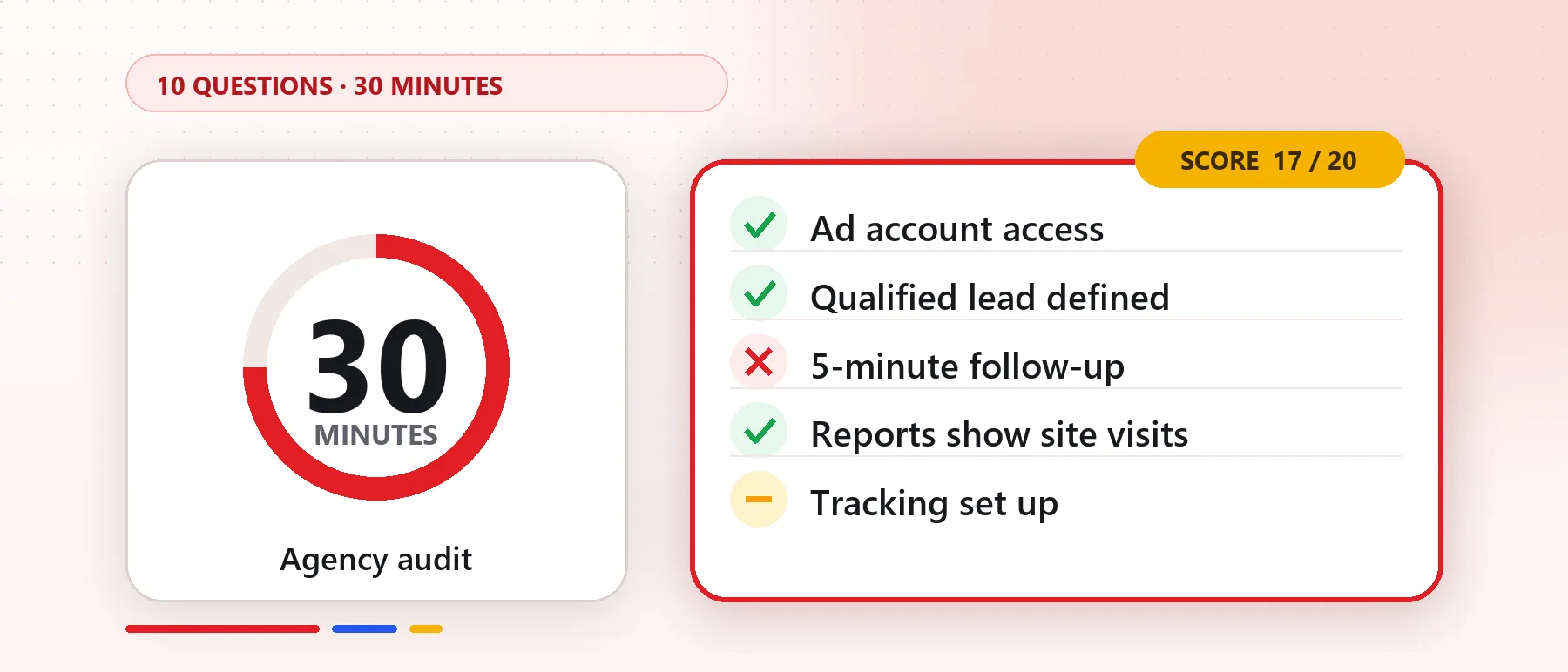
Key takeaways
- You do not need to be technical. Ten questions and thirty focused minutes are enough to tell whether an agency is delivering.
- Bring evidence: your own ad accounts, the last three reports, your CRM, your live creatives and your sales team’s view of lead quality.
- Judge on cost per qualified lead and cost per site visit, not on cost per lead, impressions or clicks.
- Score each question 0, 1 or 2. Under 11 out of 20 means you are buying activity, not results.
The leads are coming in. The report arrives on the first of every month, full of impressions, clicks and a healthy-looking graph. And yet, when you ask your sales team how many of those leads turned into site visits, the room goes quiet.
That silence is the reason this guide exists.
Most realtors and developers never audit their agency. Not because they trust it blindly, but because they don’t know what to ask. Marketing feels technical, the reports feel official, and nobody wants to look uninformed in a review call.
You don’t need to be technical. You need ten good questions and thirty focused minutes. This audit works whether you are a broker promoting one project or a developer running a full launch, and whether your campaigns run on Meta, Google or both.
Before you start: gather five things (5 minutes)
You will get far better answers if you bring evidence to the call. Open these before you start:
- Your ad accounts (Meta Ads Manager and Google Ads), with your own login.
- The last three monthly reports your agency sent.
- Your CRM or lead sheet for the same period.
- Your landing pages and ad creatives currently running.
- A note from your sales team on lead quality, in their own words.
If you can’t access item one, you have already found your first problem. Keep reading.
How the 30 minutes work
Score each question 0, 1 or 2 as you go: 0 for a red flag, 1 for a partial answer, 2 for a clear, evidence-backed answer. The scoring guide, with a scorecard you can fill in right here, is at the end.
The 10 audit questions
Tap any number to jump straight to that question.
Do I own and have full access to my ad accounts?
Minutes 0–10 · Ownership and numbersThe ad account holds your data: audiences, creatives, past performance and learning. If the agency owns it, you can lose years of insight the day you part ways.
“Yes. The accounts are in your name, you pay Meta and Google directly, and we work inside them with partner access.”
“We run it from our account and send you reports.” Or: your spend is paid to the agency, with no platform invoices.
Log in. Look at the payment method and the user list. You should see your own card or bank details, and every agency user should be visible.
How do you define a “qualified lead”, and what share of mine qualify?
Minutes 0–10 · Ownership and numbers“Leads” is the most flattering word in marketing. A lead can be a real buyer or a curious stranger who tapped a form while scrolling.
A written definition covering budget, location, purpose (end-use or investment), timeline and willingness to take a call. Then a number: “Of the leads last month, X% met that definition.”
“All leads are qualified” or “quality depends on your sales team.” Both mean nobody is measuring.
Why the price of a lead misleads
Compare a cheap lead straight off a Meta form with a screened lead that went through a landing page first. Take an entry-level project where a direct lead might cost ₹200 and a screened lead ₹600–800. If about 70% of screened leads are qualified, you pay roughly ₹1,000 per qualified lead.
The ₹200 lead only wins if at least one in five of them is a real buyer. Many aren’t. Always ask for cost per qualified lead, not cost per lead.
What happens in the first five minutes after a lead arrives?
Minutes 0–10 · Ownership and numbersBuyers enquire on several projects at once. The first brand to reply with something useful usually gets the conversation. Slow follow-up quietly wastes your ad budget.
A described, automatic sequence: an instant WhatsApp message, a qualifying question or two, and a call or booking link. Ideally a named person or system responsible for after-hours leads.
“Your sales team calls them.” That is a process owned by someone else, with no accountability.
Submit a test enquiry from your own phone on a Saturday evening. Time the reply. Note whether it was personal, relevant to the project you enquired about, or a generic “thanks for your interest.”
What are the stages from lead to booking, and where do we leak?
Minutes 10–20 · Process and follow-upA campaign is not one event. It is a funnel: enquiry, first contact, qualification, site visit scheduled, site visit done, negotiation, booking. Problems hide in individual stages, and each needs a different fix.
The agency can show your funnel in stages and point to the biggest drop. For example: “Plenty of leads are contacted, but few site visits happen. That’s a follow-up and trust problem, not an ad problem.”
The agency only reports the top of the funnel (leads) and treats everything after as “sales.”
In your CRM, count the leads at each stage for last month. If your CRM has no stages, that is itself a finding.
Where exactly are you using AI and automation?
Minutes 10–20 · Process and follow-upIn 2026, speed and consistency are what separate a good lead system from a bad one. Automation can respond instantly, nurture buyers who aren’t ready, remind them before site visits and update your CRM without anyone remembering to do it. AI can screen enquiries, summarise conversations and keep a buyer warm for months.
Specifics. For example: WhatsApp automation for instant replies, an AI assistant that asks qualifying questions, a long nurture sequence for undecided buyers, automatic site-visit reminders, and rules for when a human takes over.
“We use AI” with no example. Or the opposite: everything is manual, and your leads depend on someone’s memory.
What to look for
AI should reduce wasted calls and speed up replies. It should not replace the human conversation at the stage where a buyer wants to talk price, negotiate or visit. Ask where the handover happens.
Why this split between Meta and Google?
Minutes 10–20 · Process and follow-upWhy it matters
The two platforms do different jobs.
Creates demand
Facebook and Instagram
- You reach people who are not searching yet but fit your buyer profile.
- It rewards strong creative and clear audience thinking.
Captures demand
Search
- You appear when someone is already searching for a project, locality or type of home.
- It rewards sharp keywords and good landing pages.
Developers launching new projects often need both. A broker with a small budget may be better off concentrating on one at first.
A reasoned split tied to your goal, for example: “Meta builds awareness and pre-registration for the launch, Google captures buyers who search for the project name and area. We’ll shift budget as the data comes in.”
“We run both” with no logic, or the agency pushes the platform it’s more comfortable with whatever your goal.
In Google Ads, open the search terms report. Are people searching for relevant terms, or is your money going to irrelevant or competitor searches? Check that negative keywords exist.
Who creates my content, and how does it affect lead quality?
Minutes 10–20 · Process and follow-upContent is not decoration. Creative decides who clicks, who fills the form, who ignores you and who trusts you enough to take the call. The same budget can bring serious buyers or window-shoppers depending on what the ad says and shows.
A named process: how concepts are chosen, how many variations are tested, how often creative is refreshed, and who is accountable for it. Today, good agencies also use AI to produce and test creative faster, while keeping a human editor responsible for accuracy, compliance and brand quality.
Template posters, one creative that has run unchanged for months, or content that promises everything to everyone.
Look for these in the content
- Ads that filter. They state price range, location and the kind of buyer the project suits, so the wrong people self-select out.
- Content that builds trust before the first call. This includes founder or consultant-led videos, project explainers and honest answers to common buyer doubts.
- Compliance. In Dubai, property advertising has permit and QR requirements, and Indian states have their own RERA advertising rules. Ask how the agency handles this, and confirm current rules with the regulator.
Do your reports show site visits and pipeline, or only impressions?
Minutes 20–30 · Content, reporting and learningImpressions, reach and clicks feel like progress. They are not results. What you need to know is how many serious buyers moved toward a booking.
A report that shows spend, leads, cost per lead, qualified lead ratio, site visits booked, site visits completed, and where each lead came from. It also explains what changed and what will be tried next.
Pages of screenshots, likes and follower growth, with no link to your sales.
Take last month’s report and ask: “Could I explain to my partner how many buyers this brought?” If not, the report is the problem.
Is tracking set up properly?
Minutes 20–30 · Content, reporting and learningWithout proper tracking, you are guessing which ads work. With it, platforms learn to find more of your best leads.
The agency can explain what is being tracked: form submissions, calls, WhatsApp clicks and, if possible, which leads progressed in your CRM. They can show conversion tracking in both Meta and Google, and use UTM tags so you can see which ad or keyword produced which lead.
“We track leads” with no detail, or one tracking number for everything.
In Meta Events Manager and Google Ads conversions, look for active, recent events. If they are missing or inactive, optimisation is working blind.
What did you change last month, and what did it teach you?
Minutes 20–30 · Content, reporting and learningGood marketing is a series of small experiments. An agency that cannot say what it learned last month is running on autopilot.
Specific changes and lessons. For example: “We tested a video against a carousel, and the video brought leads who were less likely to answer calls, so we adjusted the qualifying questions.”
“Everything is running well.” Or a list of activities with no learning attached.
Bonus check
Ask what the contract says about notice period, ownership of creatives and access to data if you leave. A good agency makes leaving easy because it expects to be kept on merit.
How to score your agency
Add up your scores. The maximum is 20. Use the scorecard below to tally them as you go, or read the table underneath.
-
1Ad account ownership
-
2Qualified lead definition
-
3First five minutes
-
4Lead-to-booking stages
-
5AI and automation
-
6Meta vs Google split
-
7Content and lead quality
-
8Reports: visits and pipeline
-
9Tracking
-
10Testing and learning
Score each one 0, 1 or 2 as you go through the audit above.
| Score | What it means | What to do |
|---|---|---|
| 16–20 | A strong agency with clear process | Keep going. Use the audit each quarter to stay sharp. |
| 11–15 | Decent, but gaps in process or reporting | Share the findings and agree specific fixes in 30 days. |
| 6–10 | Weak process; you are likely overpaying for what you get | Set a clear improvement plan with deadlines, and start a backup search. |
| 0–5 | You are buying activity, not results | Secure your account access and data, then replace the agency. |
What to do after the audit
- Write down the three biggest gaps. Don’t try to fix ten things at once. Pick the three that cost you the most money or buyers.
- Share the findings in a calm, factual way. Good agencies welcome clear feedback. Say: “I reviewed these ten areas. Here is what I found. Here is what I’d like to see in the next 30 days.”
- Give a fair window. Thirty to sixty days is usually enough to see whether the process changes. Fixing tracking or follow-up can show results quickly. Fixing creative and audience takes a bit longer.
- Protect yourself first. Whatever happens next, make sure you hold your ad accounts, your CRM data and your creative files.
- If you decide to switch, test before you commit. Ask the new agency to walk you through the same ten questions. How they answer will tell you most of what you need.
Choosing an agency that scores well on this audit
If you are hiring for the first time, or replacing an agency that failed the audit, run these ten questions in reverse. Choose an agency that:
- Shows its process. It can explain stages from enquiry to booking, not just ad setup.
- Treats AI, automation and content as core parts of lead generation. Not extras bolted on later.
- Reports in your language. Site visits, qualified leads and pipeline, not vanity numbers.
- Is honest about budget. It tells you what your goal realistically needs, and says no when it cannot help.
- Gives you ownership. Your accounts, your data, your creatives.
FAQ
How often should I audit my real estate marketing agency?
Run the full 30-minute audit once a quarter, and a quick check of questions 2, 3 and 8 every month.
What are the warning signs that my agency is not working?
Plenty of leads but few site visits, slow follow-up, reports without sales numbers, no access to your ad accounts, and an agency that can’t explain what it tested last month.
Is cost per lead the most important metric?
No. Cost per qualified lead and cost per site visit tell you far more. A cheap lead that never picks up the phone is expensive.
Should realtors run Meta ads, Google ads or both?
It depends on your goal and budget. Meta is strong for building demand and reaching the right audience, and Google is strong for capturing people already searching. Many serious campaigns use both, with the split adjusted as data comes in.
Can I run this audit myself without marketing knowledge?
Yes. Most of the checks need you to look at your own accounts, your CRM and your reports, and to ask simple, direct questions.
If you want a stronger system behind your marketing
If you have a budget of ₹60,000 to ₹5 lakh a month for an agency, and you want a premium team that works on ads, AI follow-up and content together, connect with Grand Business Media. We work with realtors and developers who want clear process and honest reporting.
More from the GBM blog
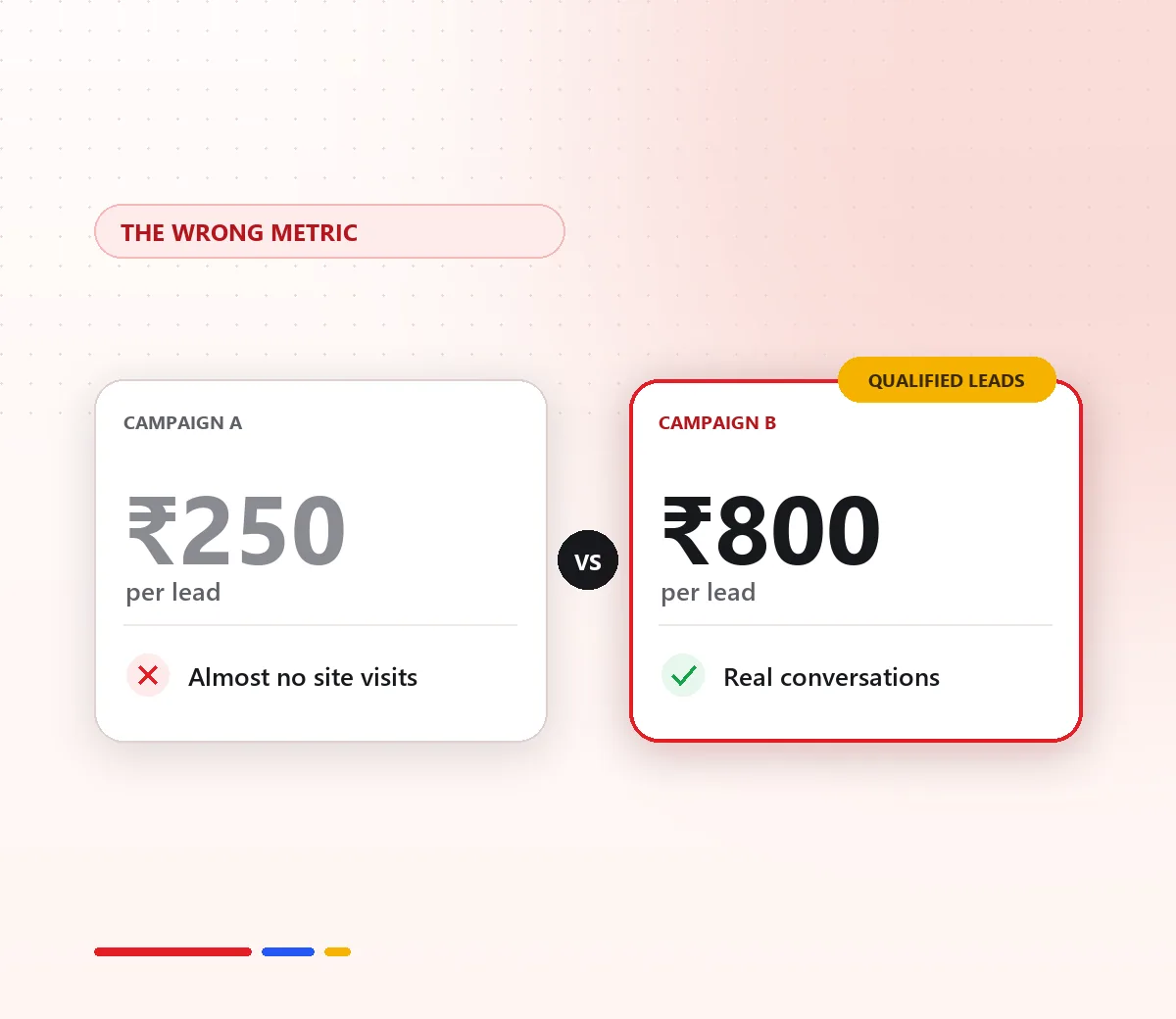
Why CPL Is the Wrong Metric in Real Estate Marketing, and What to Track Instead
Cost per lead misleads real estate marketers. See why, which metrics predict bookings, how Meta and Google really compare, and what budget closures need.
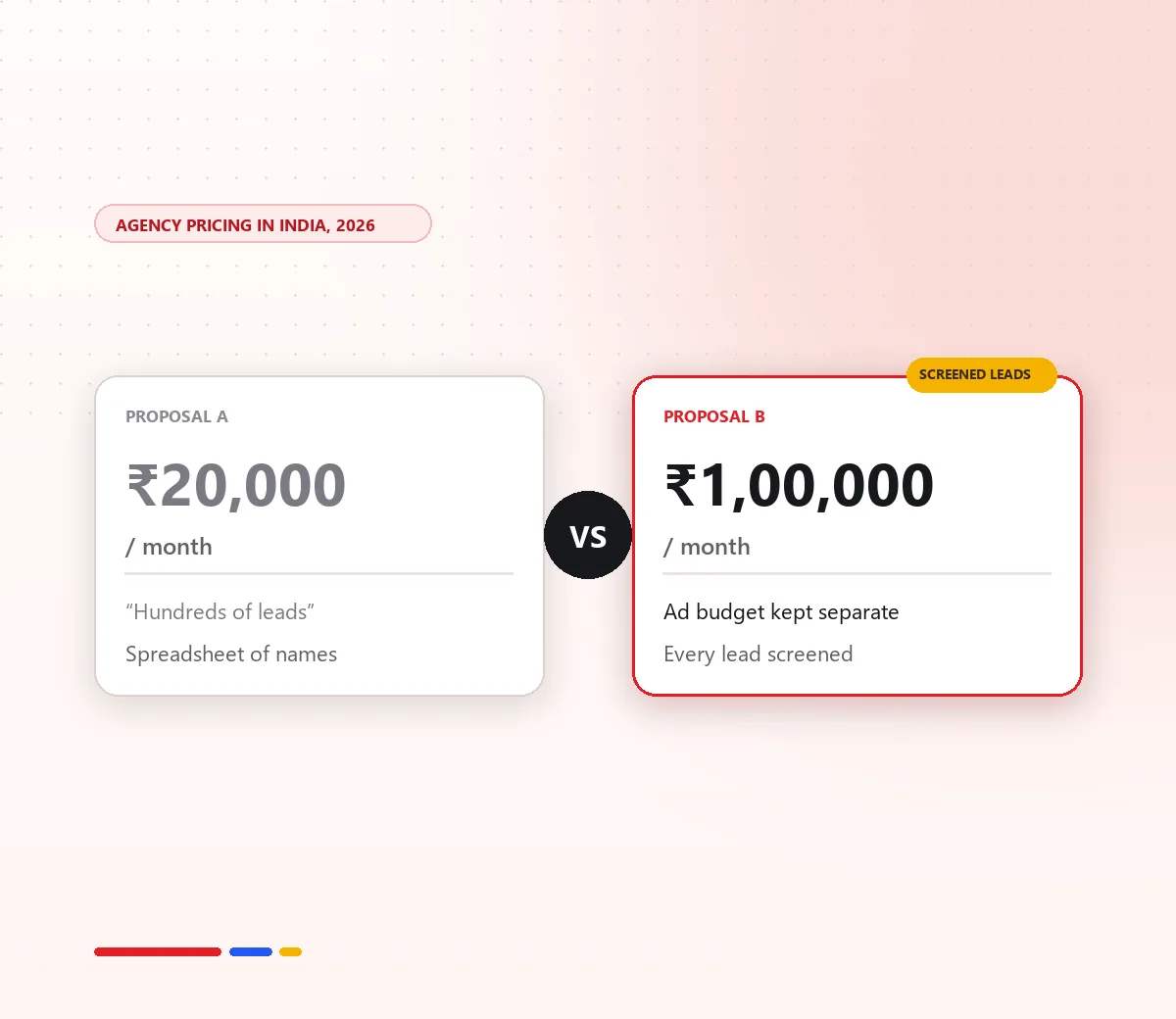
How Much Does a Real Estate Marketing Agency Cost in India? Retainer vs Performance Pricing
Real estate marketing agency pricing in India: retainer vs performance models, real lead costs, minimum ad spend and the maths most agencies hide.
Reading is step one. Let’s build your buyer pipeline.
Book a free 30-minute strategy session and we’ll map exactly how these systems would work for your projects.
Gurgaon · Dubai · Limited client seats each year