
Target Audience for Real Estate Facebook Ads in India
Who to target in real estate Facebook ads in India: buyer segments by budget and project type, location and interest choices, the housing ad rules to check, and a simple way to test audiences.

Key takeaways
- Start from the buyer, not the tool. Write down the budget, the project type and the city that each audience is for, then build one ad set per audience.
- Interest and life event options change often, and Meta applies special rules to housing ads. Check the current rules before you plan demographic filters.
- Use location and language carefully. Local language creative can help with mid-segment and regional buyers, but test it against your English creative.
- Judge audiences on lead quality and site visits, not on cost per lead alone.
Most real estate Facebook campaigns in India fail for one of two reasons. Either the audience is so wide that the budget goes to people who will never buy at that price, or it is so narrow that the campaign cannot find enough people to learn from. The fix is not a secret setting. It is a clear picture of who buys each project, and a test plan to find out which audience gives you real site visits.
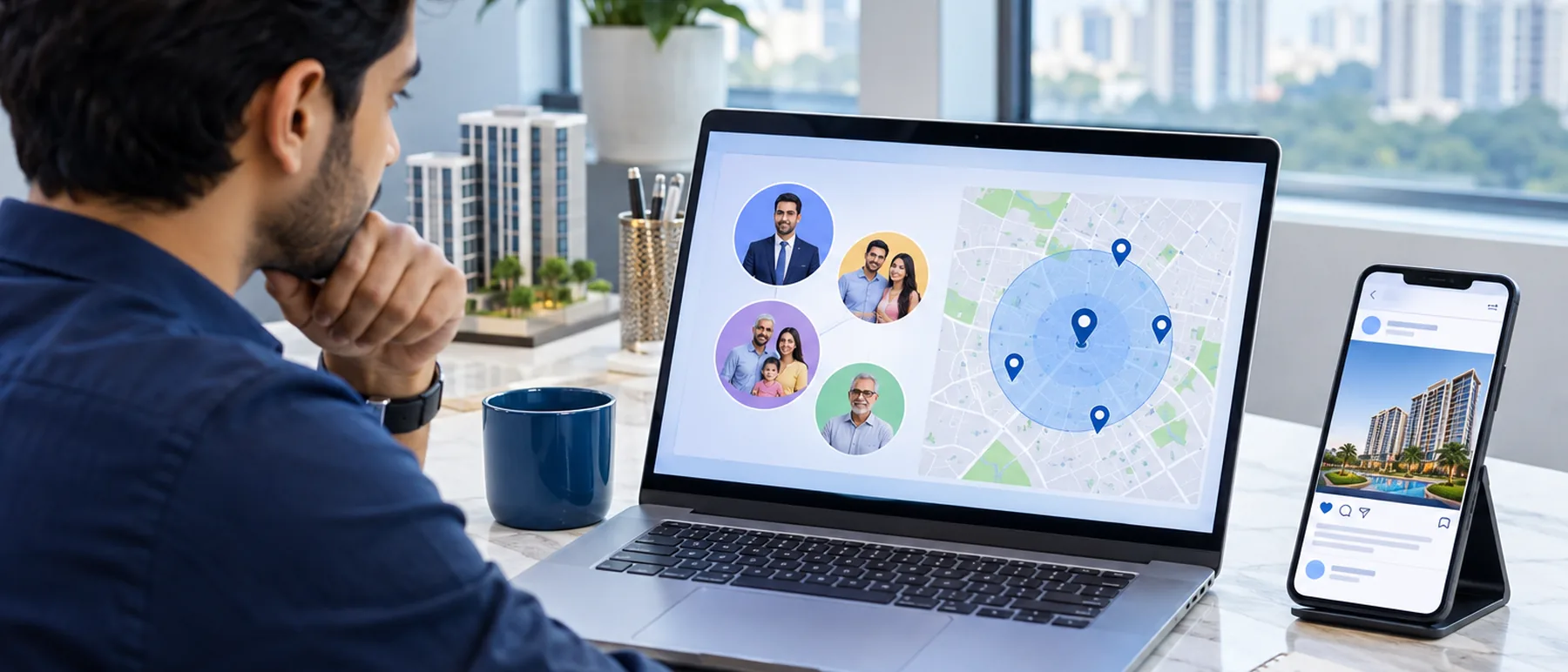
Build the audience from the buyer profile for each project: budget range, property type, city or micro-market, and reason to buy. Create one ad set per audience, use interest and location options that match that profile, check Meta current housing ad rules before you apply demographic filters, and judge each audience by qualified leads and site visits rather than by cost per lead alone.
Step 1: write the buyer profile before you open Ads Manager
For each project, answer five questions in writing: what is the price band, what unit types are on offer, who is the likely buyer (end user, investor, NRI, upgrader), which cities or areas do they come from, and what makes them act (location, possession date, payment plan, amenities). A profile like this gives you the seed for every audience you test.
Typical buyer segments in India
| Segment | What they usually want | Starting point for targeting |
|---|---|---|
| Mid-segment end users | A home they can afford with a loan, close to work or family | Nearby cities and towns, property related interests, a clear price and payment plan in the ad |
| Budget and first-time buyers | Value, reliable possession and simple paperwork | Local areas plus broad interest pools, with creative that explains the process |
| Premium and luxury buyers | Location, design, privacy and status | Narrow locations, lifestyle creative, and lookalikes built from your best booked buyers |
| NRI and overseas buyers | Remote buying, trust, and a clear process for payments and site visits | Countries and cities where NRIs live, with creative that answers trust questions |
| Investors | Appreciation potential, rental demand and exit options | Investor interests and finance related audiences, with honest creative about risks |
These are starting points, not rules. Your own lead data will tell you which segment actually books visits.
Check the housing ad rules first
In some countries, such as the United States and Canada, Meta limits targeting by age, gender, postcode and some detailed options for housing ads through its Special Ad Category rules. Whether and how this applies to your account and your target country depends on Meta's current policy, which changes over time. Before you plan a campaign, open the current advertising policy and the Special Ad Category setting in your Ads Manager, and plan your audience around what is allowed today. If you also advertise to buyers abroad, such as NRI audiences in the US or Canada, check those rules for those countries too.
Location, interests and language
- Location. Use the cities and areas that match the buyer profile. A radius around a project can work for local buyers, but check the current options Meta allows for housing.
- Interests and life events. Interest options related to property, home improvement and nearby lifestyle topics can help. Life event options change over time, so check what is available in your account.
- Language. Regional language creative can perform well in towns where buyers prefer their own language. Test it against English, and make sure your sales team can reply in that language.
- Creative. The audience only sees what the creative says. Show the price band, the location and the next step, so that the right people click and the wrong ones scroll on.
What Meta targeting looks like now
Meta has been moving advertisers toward broad audiences and its Advantage+ audience tools, and several guides say detailed interest options are now treated more as suggestions than hard filters. Sources disagree on exact dates and details, so check what your own Ads Manager allows. The controls that still matter most are location, language, your own custom audiences and lookalikes, and creative that speaks to one buyer. In practice the ad itself now does much of the targeting: the price band, the location and the project type in the creative decide who clicks.
Example audience sets to test
These are starting structures for a test plan, not proven results. Adjust the cities to your project.
| Project type | Location audiences to test | Other layers |
|---|---|---|
| Mid-segment apartments in Gurgaon or Noida | Delhi NCR core (Gurgaon, Delhi, Noida, Faridabad), then wider NCR towns | Hindi and English creative, retargeting of site visitors, lookalike of past site visitors |
| Plots or townships in Tier 2 and 3 towns | The home town plus nearby cities where families have moved for work | Regional language creative, a clear price and payment plan, WhatsApp as the main response channel |
| Luxury residences | Narrow premium micro-markets, plus metros such as Mumbai and Bengaluru | Instagram placements, video walkthroughs, lookalike of booked buyers |
| Investor and NRI offers | Gulf countries, UK, US, Canada, plus Indian metros for domestic investors | Time-zone aware follow-up, trust-led creative, a clear remote buying process |
Late-night enquiries are common in India
Many buyers browse and enquire in the evening and late at night, after work and family time. Posting-time guides for Indian audiences often put the busiest social media hours between roughly 7 PM and midnight, especially in smaller cities, though sources vary. For real estate ads this has three practical effects:
- Check your hours. Use the time-of-day breakdown in Ads Manager and your CRM to see when your own leads arrive, instead of guessing.
- Reply instantly, even at night. Set an automatic WhatsApp or SMS acknowledgement so an 11 PM enquiry gets a message in seconds, then a human callback in the morning.
- Do not call at night unless invited. Calls after about 9 or 10 PM annoy buyers. Promise a time ("I will call you tomorrow at 10 AM") in the first message.
How to test audiences without wasting budget
- Set up three to four audiences that differ in one clear way, such as location or segment. Keep the creative the same across them.
- Give each audience a fixed daily budget for one to two weeks, so no single audience takes everything.
- Track the full path. Count enquiries, qualified leads (the ones your team confirms are real buyers), site visits and bookings for each audience.
- Pause the weakest audience only after it has had enough budget to give a fair result. Move the budget to the best one and test a new audience against it.
If you are not sure how to read the results, our guide on why cost per lead is the wrong metric explains what to track instead. For the lead quality side, see our guide to why real estate ads bring junk leads.
Common audience mistakes
Targeting everyone in the country. Your budget goes to people who cannot buy at that price or in that location.
Judging by form fills. A cheap lead that never answers is not a result.
Building lookalikes from every enquiry. Use your best customers or booked buyers as the source.
Changing the audience and the creative at the same time. You will not know which change helped.
Frequently asked questions
Who is the target audience for real estate Facebook ads in India?
It depends on the project. Mid-segment and budget projects usually target people in nearby cities and towns who have stated an interest in property or who are in the right age and income range for the price. Luxury projects usually need narrower, higher-intent audiences. Start with the buyer profile for each project.
Can I target by age, gender and income for real estate ads in India?
Meta applies special rules to housing ads, which can limit some demographic and location filters. Check Meta current housing ad policy in your Ads Manager before you plan your targeting, and confirm the rules with Meta support if you are unsure.
Should I use Facebook or Instagram for real estate ads?
Both run on the same Meta ads system. Many teams run one campaign across both placements and check which one brings better leads. Instagram placements often suit visual, premium project creative, while Facebook placements can work well for mid-segment offers. Test both before deciding.
Do custom audiences and lookalikes help?
They can, if you have enough quality data. A custom audience from past site visitors, enquiries or your own contact list is often a good starting point. A lookalike is only as good as its source list, so use your best customers or booked buyers, not every enquiry.
How long should I test an audience before deciding?
Give each audience enough budget and time to produce leads, then check qualified leads and site visits, not only the number of forms filled. Many teams review after one to two weeks, but the right window depends on your budget and sales cycle.
Is local language creative worth it?
It can be, especially in towns where buyers prefer their regional language. Test a regional language version against English, and check that your sales team can respond in the same language, or the lead will go cold.
Want help building audiences that bring site visits?
Grand Business Media runs Meta lead generation for real estate projects, from audience design and creative through to lead follow-up. If you want a test plan built around your project and your buyers, talk to us.
More from the GBM blog

Best Real Estate Landing Page Design: Examples and Checklist
What a high-converting real estate landing page needs: one goal, a clear offer, a short form, honest project imagery, trust signals and mobile testing, plus a checklist to review your page before you run ads.
Best CRM for Real Estate in India: 8 Options Compared (2026)
A side by side comparison of the CRMs Indian brokers, agents and developers actually shortlist: Sell.Do, LeadSquared, Zoho CRM, Salesforce, TeleCRM, Kylas, Buildesk and general tools such as Bitrix24 and HubSpot, with features, best fit, reported pricing and a way to choose.
Reading is step one. Let’s build your buyer pipeline.
Book a free 30-minute strategy session and we’ll map exactly how these systems would work for your projects.
Gurgaon · Dubai · Limited client seats each year