
Why Your Real Estate Ads Bring Junk Leads in Gurgaon, and How to Fix Meta and Google Campaigns
Why Gurgaon developers get junk leads from Meta and Google ads, and the fixes: fast response, 100-touch follow-up, Meta targeting, retargeting, Google setup and tracking.

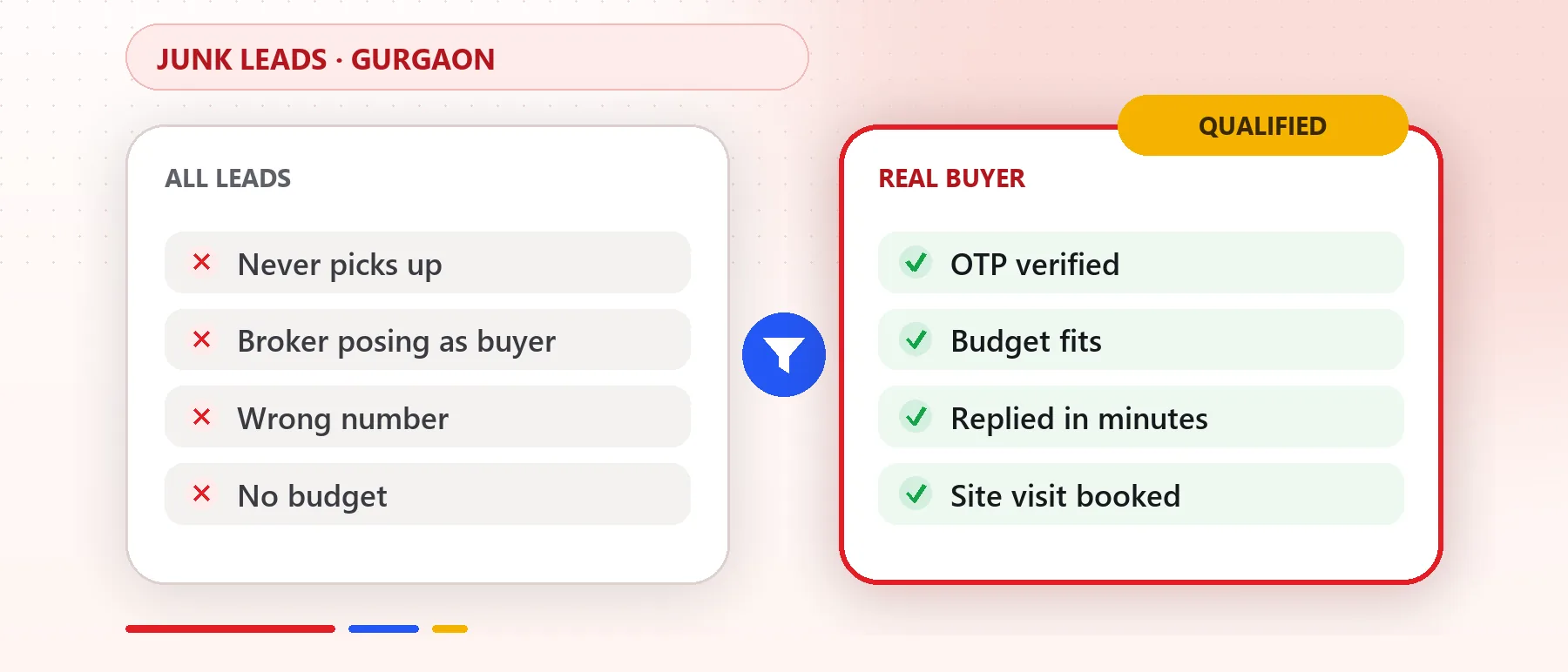
Key takeaways
- Most “junk” in Gurgaon real estate is real interest that went cold. Fix speed and follow-up first, then fix who sees your ads.
- Connect within 60 seconds to 5 minutes, and keep a long, useful follow-up of around 100 touches a year.
- On Meta, layer location with affluence signals, seed lookalikes from real buyers, retarget in a ladder, and exclude brokers and existing leads.
- On Google, structure by intent, keep negative lists, and send qualified-lead data back to both platforms so they learn what “good” means.
Yesterday, a buyer saw your ad and filled in the form. They were genuinely interested. You can see it in the answers they gave.
Today, you call. The phone rings out. You call again. They pick up and say, “I’m not interested right now.” Your team marks the lead as junk, the report shows another bad batch, and the blame goes to the ads.
“Not interested right now.” Marked as junk. The ads get the blame.
Real interest yesterday. A job, a family and a dozen other projects today.
But look at it from the buyer’s side. Yesterday they had a free moment and a flash of interest. Today they have a job, a business, a family and a phone full of calls. In the same 24 hours, Google and Meta showed them ads for a dozen other projects. They also filled in a few other forms. Now your call is one of many, and you are not their priority.
That is the biggest source of “junk” in Gurgaon real estate. But it is not the only one.
Some junk is fake, some is brokers, and some comes from targeting the wrong people in the first place. This guide covers all of it: what causes junk leads, and then, in detail, the fixes on both sides of the click: the follow-up system, Meta targeting and retargeting, Google campaign structure, forms, and tracking.
Quick answer
- Slow, thin follow-up. Interested buyers go cold. Fix: connect within 60 seconds to 5 minutes, and run a long, useful follow-up of around 100 touches a year.
- Wrong audience or wrong intent. The ad reaches people who cannot or will not buy. Fix: layered targeting on Meta (location, interests, behaviours, lookalikes, retargeting, exclusions) and a tight keyword structure on Google.
- No filter at the door. Anyone can submit anything. Fix: a self-hosted page or higher-intent form, OTP, qualification questions, a broker filter, and a feedback loop that teaches the platforms what a good lead looks like.
In this guide. Tap a fix to jump straight to it.
The types of junk leads (ranked by how often we see them)
| Rank | Junk type | What it looks like |
|---|---|---|
| 1 | Never picks up / “not interested right now” | Filled the form, then unreachable or cold the next day |
| 2 | Brokers posing as buyers | Competing agents collecting project details |
| 3 | Fake or wrong numbers | Invalid, disconnected or random digits |
| 4 | No budget | Genuine interest, but far below your price range |
| 5 | Duplicates | The same person submitting through several ads |
In our experience, the top two types cause most of the pain. Types 3 to 5 are mostly targeting and form problems, which Fixes 3 to 7 below address directly.
Why interested buyers go cold
After the click, the buyer’s day looks like this: they enquired on several projects, ads for more projects followed them across Instagram, Facebook and YouTube, and by the next morning several teams were calling and messaging them. Your call arrives as one more interruption from a stranger. The interest was real. The timing was not.
If your only follow-up is two or three calls in the first week, the buyer drifts away and the report says “junk”. The fix is not a different buyer. It is being present when this buyer is ready again.
Fix 1: Connect within 60 seconds to 5 minutes
Speed is the cheapest improvement, and it costs nothing in ad spend. A buyer is most interested at the moment they submit. Every hour of delay gives another advertiser the chance to reach them first.
- Send an instant WhatsApp message that names the project and thanks them.
- Trigger a call within minutes, by your team or an AI voice assistant, including at night and on weekends.
- Ask one easy qualifying question in the first message, such as budget range or preferred configuration.
- Offer a clear next step: a call slot, a brochure or a site-visit booking link.
- Message before you call, so your number is not a stranger’s when the phone rings.
In our experience, contacting leads within the first 60 seconds to 5 minutes lifts the share of quality leads by about 40–50%. These are figures from our campaigns, not guarantees. They depend on the project, price band and sales team.
Fix 2: The 100-touch system
One call is not follow-up. A buyer who is busy today may be ready in a month, three months or a year. Our rule: touch every lead around 100 times in a year, using automation. It sounds like a lot until you see that most touches are low-effort, value-adding contact, not sales calls.
| Period | Touches | Examples |
|---|---|---|
| Day 0 | 5 | Instant WhatsApp, call attempt, email with brochure, follow-up message, second call |
| Days 1–7 | 10 | Project video, floor plan, FAQ answer, site-visit invitation, missed-call follow-up |
| Weeks 2–4 | 10 | Construction update, testimonial, micro-market guide, payment plan explainer |
| Months 2–3 | 20 | Weekly useful content, event invitations, real price or scheme updates |
| Months 4–6 | 20 | Market updates, delivery progress, retargeting ads, check-in calls |
| Months 7–12 | 35 | Festive greetings, new-phase announcements, reactivation offers, personal check-ins |
Keep it welcome, not annoying:
- Lead with value. Update, answer, explain. Not “Have you decided?” every day.
- Mix channels: WhatsApp, email, calls, retargeting ads and content.
- Segment. A ₹2 Cr investor and a ₹10 Cr end-user need different messages.
- Respect consent. WhatsApp Business needs opt-in and approved templates, and calls and SMS fall under TRAI rules including DND. India’s data protection law also applies. Offer an easy opt-out and check current requirements with your legal advisor.
- Hand over to a human the moment the buyer replies or shows intent.
In our experience, building 30–40 or more touchpoints into the follow-up lifts overall quality-lead results by about 70–80%. Again, our figures, not promises.
Fix 3: Meta targeting that attracts buyers, not browsers
Meta shows your ad to people based on who you point it at, and its auction charges more to reach affluent audiences. As a rule, broader targeting lowers CPL but lowers quality, and narrower, wealthier targeting raises CPL but improves it. The job is to choose the right trade-off for your ticket size, not to chase the lowest CPL.
Meta changes its targeting menus often, and automated “Advantage+” audiences treat your interests as suggestions rather than hard limits. Names such as the ones below may be renamed, merged or removed. Check what is available in your Ads Manager, and test rather than assume.
Step 1: Decide who the buyer actually is
Write the buyer down before you open Ads Manager. The targeting changes with the ticket size.
| Ticket size | Likely buyer | Targeting direction |
|---|---|---|
| Entry (under ₹50 L to ₹1 Cr) | First-time buyers, salaried families, small investors | Broader audiences work. Lean on location and creative to filter. |
| Mid (₹1–5 Cr) | Established professionals, business owners, upgraders | Layer location with income-linked interests and behaviours |
| Premium (₹5–10 Cr) | Senior professionals, business owners, existing property owners | Narrower, affluence-led audiences; lookalikes from past buyers |
| Luxury (₹10 Cr+) | HNI and UHNI, second-home and international buyers | Narrow, high-affluence signals; expect a higher CPL |
Step 2: Layer affluence signals
For premium and luxury projects, pair your location with lifestyle signals that suggest spending power. The kinds of signals that work:
- Golf. Interests such as golf, golf clubs and golf equipment. This suits Golf Course Road and Golf Course Extension Road projects especially well, because the lifestyle matches the address.
- Frequent international travellers. Meta has offered a “frequent international travellers” behaviour, which suits NRI-return buyers, second-home buyers and luxury inventory.
- Premium cars. Interests in luxury car brands (for example Mercedes-Benz, BMW, Audi, Porsche) pick up people who already spend at that level. Premium-brand ownership is a rough proxy for ticket-size fit.
- Business and luxury travel. Business-class travel, luxury hotels and premium airlines.
- Wealth and business signals. Entrepreneurship, investing, wealth management, private banking, business owners, and senior job titles where available.
- Premium devices. Where available, newer high-end smartphones can be a soft signal.
Three rules for layering:
- Combine, don’t just stack. Layering location and one or two affluence signals beats ten interests in a single bucket. Over-narrow audiences stop delivering and push your CPL up.
- Test audiences in separate ad sets. Run golf, travellers, cars and lookalikes side by side, then judge each by qualified leads and site visits, not CPL.
- Let the creative do half the job. Targeting suggests who might see the ad. The creative, price and offer decide who clicks (see Fix 5).
Step 3: Choose locations with intent
- Radius around the project for people who can visit easily.
- Affluent source localities for premium and luxury buyers, such as established South and Central Delhi neighbourhoods (Vasant Vihar, Golf Links, Greater Kailash, Defence Colony), plus Gurgaon’s own existing premium sectors and DLF phases.
- Corporate and business hubs where your buyer works.
- NRI hubs (see below), run as a separate campaign with separate messaging.
Step 4: Build lookalikes from a quality seed
A lookalike is only as good as the list it learns from. Do not seed it with every raw lead. Seed with:
- Buyers and bookings.
- Leads who completed a site visit.
- Leads who passed your qualification questions.
- A cleaned list with duplicates, brokers and invalid numbers removed.
Start with a close lookalike and widen only after you have a stable qualified-lead flow. Refresh the seed as your sales data grows.
Step 5: Run NRI targeting as its own campaign
NRI buyers behave differently, and their CPL is higher (see our CPL guide). Keep them separate:
- Target the countries where your NRI buyers are (for example Canada, the UK, Australia, the US, the UAE).
- Use messaging about ownership, rental management, legal clarity and virtual site visits.
- Use time-zone-aware follow-up, so calls arrive at a sensible hour for them.
- Note that Meta applies special rules to housing ads in some countries, such as the US and Canada, which can limit the targeting options available. Check the current policy before you build.
Fix 4: Retargeting and exclusions, the cheapest quality you can buy
Retargeting is where many Gurgaon campaigns win or lose. People who already showed interest are cheaper to convert than strangers. Exclusions stop you paying again for people you should never reach.
The retargeting ladder
| Audience | Who | What to show |
|---|---|---|
| Video viewers | Watched a meaningful share of a project video | A floor-plan or walkthrough ad |
| Page and profile engagers | Engaged with your Instagram or Facebook page | A testimonial, location advantage or construction update |
| Website visitors | Visited the project page but did not enquire | Price range, payment plan, site-visit offer |
| Form starters | Opened the form but did not submit | A reminder with a simpler way to enquire (WhatsApp or call) |
| Existing leads not yet visited | In your CRM, no site visit | Content that moves them to a visit: neighbourhood, delivery progress, resale value |
| Past visitors who did not book | Visited, did not book | A direct invitation, new inventory or a new phase |
This is part of the 100-touch system: retargeting ads are some of the cheapest touches you can add. It needs your Meta Pixel and Conversions API to be set up properly.
Exclusions that clean up your leads
Add these as exclusions (custom audiences or settings) to stop wasted spend:
- Existing leads and customers, so you do not pay to reach them again as “new” leads.
- Brokers and channel partners. Upload your known broker and channel-partner numbers and emails as a custom audience and exclude it.
- Your own team, vendors and employees.
- Real estate agent interests and job titles, where available.
- Recent converters, to avoid duplicate enquiries from the same person.
Placements and settings
- Prefer Facebook and Instagram feeds, Stories and Reels, where your creatives are most controlled.
- Be cautious with low-quality placements such as the Audience Network. Review placement reports and cut those that bring lead volume without site visits.
- Review frequency. A buyer who sees your ad too often stops noticing it, or gets annoyed.
- Keep an eye on how Advantage+ settings expand your audience beyond what you chose.
Fix 5: Make the creative and the form do the filtering
Targeting puts the ad in front of the right people. The ad and the form then decide who raises their hand.
Creative as a filter
- Show the price range, location, configuration and possession status in the ad. Someone who cannot afford it will not click, and you saved a junk lead.
- Speak to the specific buyer. “3 BHK on Golf Course Extension Road” filters better than “Luxury living in Gurgaon”.
- Avoid giveaways and gimmicks. They attract bargain hunters.
- Use real photos, real videos and real RERA details where permitted. Follow RERA and HRERA advertising rules, and check them with your compliance advisor.
- Rotate creatives before they tire, and test one variable at a time.
Forms that filter
- Prefer a self-hosted landing page or form where you control the questions, the OTP and the routing. If you use Meta’s built-in instant forms, choose the higher-intent form type (which adds a review step) over the volume-first type, and add custom questions such as budget and purpose.
- Consider click-to-WhatsApp ads, which start a conversation. You can qualify the buyer inside the chat before they reach a human.
- Keep qualification short but real, typically five to eight questions.
Optimise for quality, not form fills
Where available, use Meta’s optimisation for qualified or “conversion” leads instead of raw leads, and feed it your CRM stage updates through the Conversions API (see Fix 8).
Fix 6: Google campaigns that capture intent without the noise
Google leads are usually more intentional than Meta leads, because the buyer typed a need. That is also why a messy setup is expensive: you pay for every click, including the wrong ones.
Structure by intent, not by project alone
| Layer | Examples | Notes |
|---|---|---|
| Brand | Your project and developer name | Protects your own searches. Usually the highest quality. |
| Micro-market plus configuration | “3 BHK Dwarka Expressway”, “apartments Golf Course Extension Road” | The core of most campaigns |
| Buyer-intent modifiers | Price, brochure, floor plan, possession, payment plan | Close to the decision |
| Competitor or generic terms | Competitor project names, “flats in Gurgaon” | Test with care. They often bring brokers and browsers. |
Targeting and settings that cut junk
- Negative keywords. Start with rent, PG, jobs, free, cheap, resale (if you do not want it), second-hand, broker, dealer, agent and channel partner, and review the search terms report weekly. Keep shared negative lists across campaigns.
- Match types. Start with exact and phrase match. Use broad match only with strong tracking and negative lists.
- Location setting. Use “presence” rather than “presence or interest” for local campaigns, so people merely searching about Gurgaon from elsewhere do not drain budget. For NRI campaigns, do the opposite on purpose, and build them separately.
- Audience layering. Add in-market and affinity audiences and your own customer lists in observation mode, then bid up the segments that bring qualified leads. Use customer match with cleaned buyer lists.
- Ad schedule. Review when your qualified leads actually arrive and when your team can respond. Do not pay for clicks at hours when nobody can call back.
- IP exclusions. Where you see repeated clicks from broker or competitor offices, consider excluding those IPs.
- Ad copy that filters. State price range, configuration and location in the headline and description, so only matching buyers click.
- Assets. Use call, location and sitelink assets. For calls, set a minimum call length before counting a conversion.
Performance Max and Demand Gen
Use Performance Max only once you have clean conversion tracking, and feed it audience signals plus brand exclusions and URL rules where available. Without them, it can find cheap, low-quality conversions. Demand Gen (YouTube, Discover, Gmail) can be useful for lookalike-style reach, but treat it as an awareness and retargeting layer, not your core.
Landing page match
Send “3 BHK Dwarka Expressway” searchers to a page about exactly that: price range, plans, the neighbourhood, a clear form with OTP. A generic page wastes the intent you paid for.
Fix 7: Filter the genuine junk at the door
| Problem | Fix |
|---|---|
| Fake or wrong numbers | OTP phone verification before the lead is accepted |
| Duplicates | Match numbers in your CRM and merge repeat enquiries |
| Brokers | Ask “Are you buying for yourself or are you an agent?” and route brokers to your channel-partner team |
| No budget | Ask for a budget range, and route low-fit leads to nurture instead of sales |
| Not serious | Five to eight qualification questions: budget, configuration, purpose, timeline, location, willingness to visit |
Many brokers are valuable partners. The point is not to block them, but to keep them out of the buyer count and the buyer journey.
Fix 8: Close the feedback loop, so the platforms learn what “good” means
This is the fix many campaigns miss. If Meta and Google only hear “form submitted”, they find more people who submit forms. Teach them what a real lead looks like.
- Define stages in your CRM: raw lead, contacted, qualified, site visit, booking.
- Send a qualified-lead event back to Meta (Pixel and Conversions API) and import offline conversions into Google (using click IDs).
- Optimise for the qualified stage, not the form fill, once you have enough volume.
- Tag every rejected lead with a reason (broker, fake number, budget, not interested, duplicate), and review the reasons weekly. Each reason points to a specific fix above.
- Report on cost per qualified lead and cost per site visit, not just CPL. We explain this in our guide, Why CPL Is the Wrong Metric in Real Estate Marketing, and What to Track Instead.
A 14-day clean-up plan
| Days | Focus | What to do |
|---|---|---|
| 1–2 | Audit | Review the last 100 leads: answered, brokers, invalid numbers, speed of first contact, and the rejected-lead reasons |
| 3–5 | Speed | Instant WhatsApp, a call trigger within five minutes, and an owner for after-hours leads |
| 6–8 | Door filter | Self-hosted page or higher-intent form, OTP, qualification questions, broker question |
| 9–10 | Meta audiences | Rebuild audiences by ticket size, test golf, travellers and premium-car layers, seed lookalikes from quality leads |
| 11–12 | Retargeting and exclusions | Build the retargeting ladder, upload broker and existing-lead exclusions |
| 13 | Add negative lists, tighten match types, set the location setting, rewrite ads to show price and location | |
| 14 | Feedback loop | Send qualified-lead events to Meta, set up offline conversion import for Google, build the 30-touch sequence |
What to expect from the fix
In Gurgaon, many developers tell us that most of their leads feel like junk, often 80%, sometimes 90% or even 100%. After a fix, our experience is:
- Faster first contact (60 seconds to 5 minutes): roughly 40–50% more quality leads.
- A longer cadence (30–40 or more touches): roughly 70–80% overall improvement in quality-lead results.
Better targeting, exclusions and tracking add to this by raising the share of real buyers entering the funnel, but we cannot give you a reliable figure for them, because they depend on your project, price band and competition. These are indicative figures from our work, not guarantees. The direction is clear: fix what happens after the click, then improve who clicks.
Common mistakes
- Blaming the ads first. Check follow-up before you change the targeting.
- Chasing the lowest CPL. Broad audiences are cheap and noisy. Judge by qualified leads.
- Seeding lookalikes with every raw lead. The audience learns to find more junk.
- Stacking too many interests. Over-narrow audiences stall delivery and raise cost.
- No exclusions. You pay to reach brokers, existing leads and your own team.
- Calling two or three times, then giving up.
- Counting form fills as success. Track qualified leads and site visits.
- Spamming the buyer. Volume without value hurts your brand.
- Skipping consent. Messaging rules exist for good reason.
FAQ
Why do I get so many junk leads from Meta and Google ads?
Often the leads are genuine but go cold because follow-up is slow and thin. True junk comes from broad or wrong targeting, weak forms, fake numbers, brokers posing as buyers and unfiltered keywords.
How fast should I contact a real estate lead?
As fast as possible. In our experience, connecting within 60 seconds to 5 minutes lifts the share of quality leads by about 40–50%.
How many times should I follow up with a real estate lead?
We aim for around 100 touches in a year, using automation, with mostly value-adding contact across WhatsApp, email, calls and content. In our experience, 30–40 or more touchpoints lift quality-lead results by about 70–80%.
How should I target HNI buyers on Meta for a luxury project?
Combine a tight location with affluence signals such as golf, premium car brands, frequent international travel and business or luxury travel, then add lookalikes built from real buyers and retarget visitors. Expect a higher CPL than broad audiences, and judge results by qualified leads and site visits. Meta’s targeting options change often, so check what is available in your Ads Manager.
How do I stop brokers and fake numbers?
Use a self-hosted landing page or higher-intent form with OTP phone verification, ask whether the person is a buyer or an agent, exclude your broker list from Meta audiences, add broker-related negative keywords on Google, and block duplicates in your CRM.
What retargeting should a real estate campaign use?
Retarget video viewers, website visitors, people who started but did not submit the form, existing leads who have not visited, and past visitors who did not book, each with a different message. Exclude existing leads, customers, brokers and your own team.
Which is better for lead quality, Meta or Google?
Google leads are usually more intentional because buyers are searching, while Meta builds a wider pool of future buyers. Both go cold without fast follow-up. Many developers use both.
How much CPL is normal for real estate?
It depends on ticket size. A ₹30 lakh, ₹3 Cr and ₹30 Cr property attract different buyers and have very different CPLs. See our CPL guide for ranges.
If you want a stronger system behind your marketing
If you have a budget of ₹50,000 to ₹1.5 lakh a month for an agency, and you want a premium team that works on ads, AI follow-up and content together, connect with Grand Business Media. We work with realtors and developers who want clear process and honest reporting.
More from the GBM blog
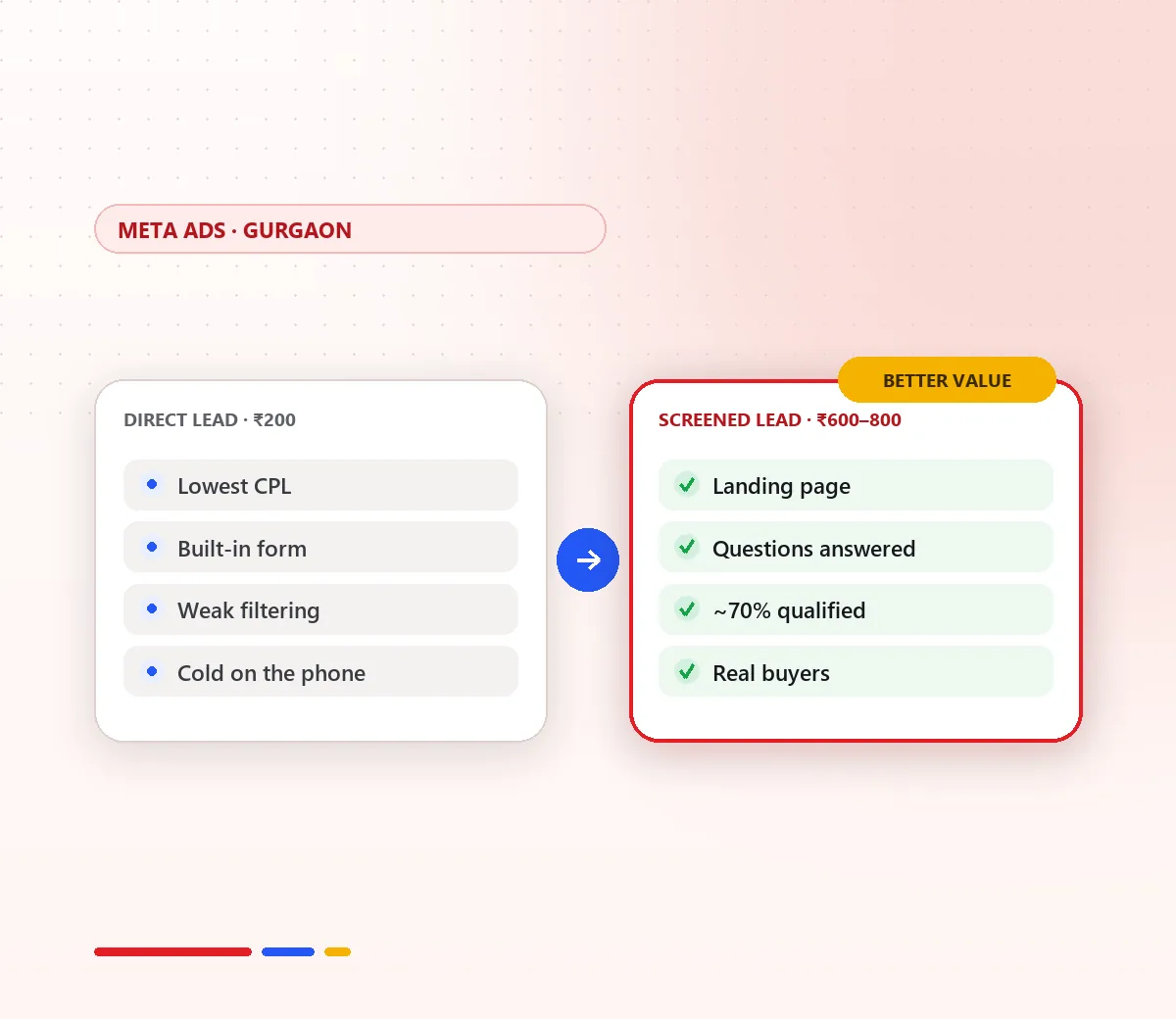
Meta Ads for Real Estate Developers in Gurgaon: How to Lower CPL and Get Qualified Leads
How Gurgaon developers lower Meta ads CPL without losing lead quality: audience cost, landing pages, lookalikes, creative, tracking and budgets by ticket size.
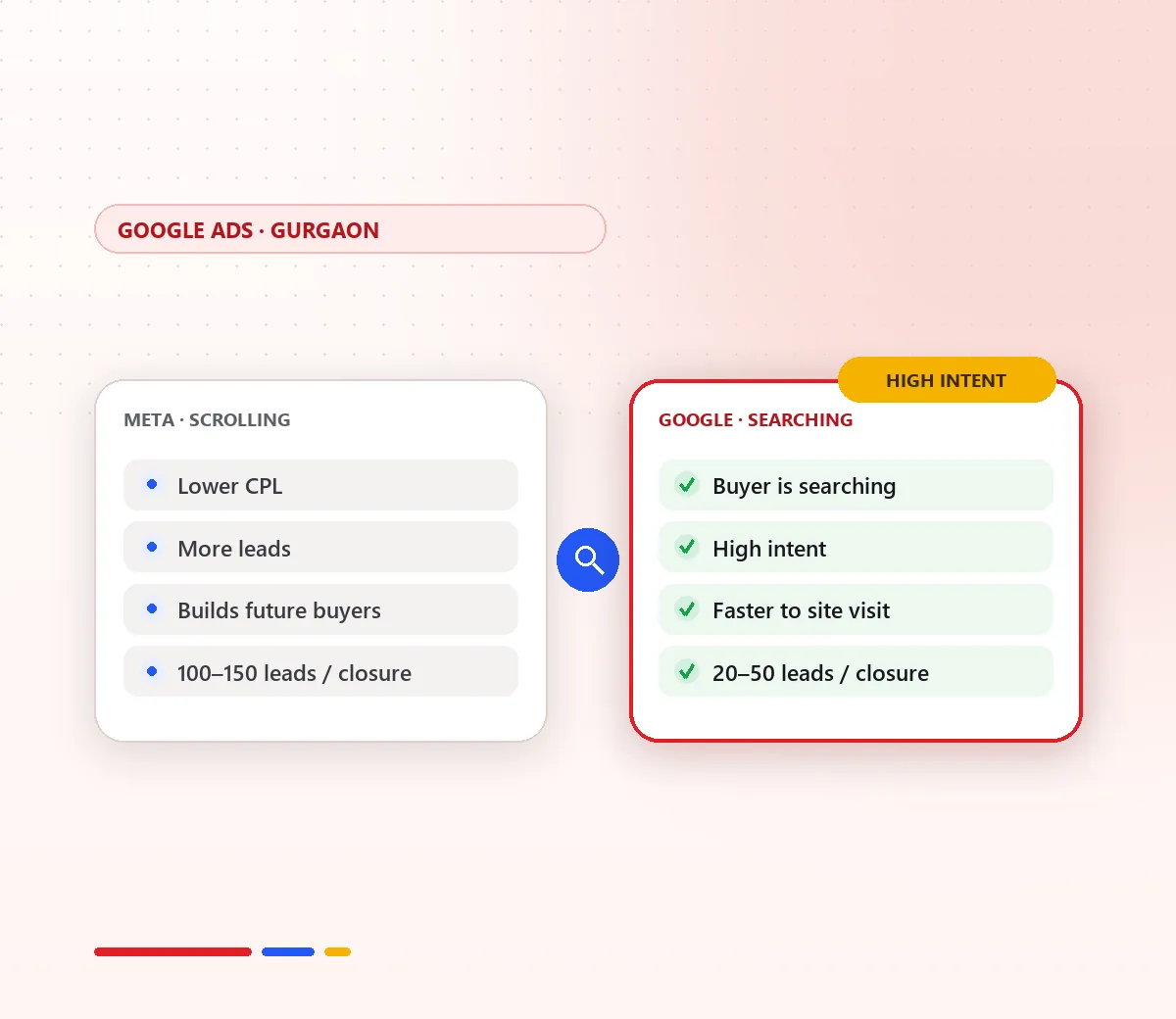
Google Ads for Real Estate in Gurgaon: How Developers Capture High-Intent Buyers
How Gurgaon developers use Google Ads to capture buyers already searching: keywords, ads, landing pages, tracking, CPL and budgets by ticket size.
Reading is step one. Let’s build your buyer pipeline.
Book a free 30-minute strategy session and we’ll map exactly how these systems would work for your projects.
Gurgaon · Dubai · Limited client seats each year