
Meta Ads for Real Estate Developers in Gurgaon: How to Lower CPL and Get Qualified Leads
How Gurgaon developers lower Meta ads CPL without losing lead quality: audience cost, landing pages, lookalikes, creative, tracking and budgets by ticket size.

Key takeaways
- Lowering CPL is easy: broaden the audience. Lowering it without lowering lead quality is the real job.
- Meta runs an auction, so HNI audiences cost more to reach and broad audiences cost less. A ₹10 Cr project and a ₹60 lakh one cannot expect the same CPL.
- Five levers lower cost per qualified lead: audience breadth, a landing page or self-hosted form, lookalikes from real buyers, retargeting and creative that filters.
- Measure cost per qualified lead and cost per site visit, and reply within minutes so every lead you pay for is worth something.
Every developer running Meta ads in Gurgaon eventually asks the same question: why is my CPL so high?
Here is the uncomfortable answer. You can lower your cost per lead quickly. You broaden the audience, the platform shows your ad to more people for less money, and the number on the dashboard drops. A week later your sales team tells you the leads are not picking up the phone.
More people, less money per lead. A week later, nobody picks up the phone.
Sharper creative, a filtering page, real-buyer audiences and fast follow-up.
Lowering CPL is easy. Lowering it without lowering lead quality is the real job.
This playbook shows how Meta pricing works, what actually moves cost per lead for Gurgaon projects on Golf Course Road, Golf Course Extension Road and Dwarka Expressway, and how to measure success by cost per qualified lead.
Quick answer
To lower CPL on Meta for Gurgaon real estate, you have two honest levers. Lever one: widen the audience, which lowers cost but also lowers average buyer quality. Lever two: improve everything around the ad, meaning sharper creative, a landing page or self-hosted form that filters buyers, lookalike and retargeting audiences built from real buyer data, proper tracking, and fast follow-up. Lever two lowers your cost per qualified lead, which is the number that matters.
In this guide. Tap a section to jump straight to it.
Why Meta charges more for some audiences than others
Meta runs an auction. You are not paying for a click or a lead directly. You are paying to reach people, and the price of reaching someone depends on how many other advertisers want to reach the same kind of person.
That is why audience quality and ad cost move together:
Costs more per lead
Wanted by many advertisers at once
- Luxury brands, banks and developers all bid for them.
- Higher cost to reach, so each lead costs more.
Costs less per lead
Cheaper to reach
- Fewer advertisers compete for them.
- But far fewer can afford a ₹3 Cr or ₹10 Cr home.
In our experience, this is the single biggest reason CPL varies so much between projects. A ₹10 Cr Golf Course Road project and a ₹60 lakh apartment cannot expect the same CPL, because they are fishing in very different ponds.
The lesson: do not chase a low CPL number in isolation. Ask who the lead is, not just what it cost.
The Gurgaon context: competition keeps rising
Gurgaon remains the centre of NCR real estate, and more projects are competing for the same buyers.
- Prices up, volumes softer. ANAROCK’s April–June 2026 data, as reported by The Tribune, shows NCR prices up about 13% year on year while NCR home sales fell about 6%, with premium Gurgaon corridors driving the price rise.
- Dwarka Expressway is a magnet. Outlook Money, citing Magicbricks, reports apartments averaging ₹14,661 per sq ft in Q2 2026, up from ₹12,525 in 2024.
- Golf Course Extension Road is crowded. Business Today reported roughly ₹35,000 crore of luxury launches planned there.
When many projects target the same corridors and the same buyers, attention gets more expensive and generic creatives get ignored. Standing out on creative and filtering on the back end matters more than ever.
What CPL to expect, by ticket size
From GBM’s campaign experience, here is how Meta CPL in India typically moves with property value. These are indicative, not guarantees.
| Property value | Typical Meta CPL (India) |
|---|---|
| Around ₹2 Cr | ₹200–₹400 |
| Around ₹5 Cr | About ₹800 |
| ₹10 Cr and above | ₹1,500–₹2,000 |
There are also two ways to buy a lead, and the price differs a lot:
| Price band | Direct lead (Meta form) | Screened lead (landing page) |
|---|---|---|
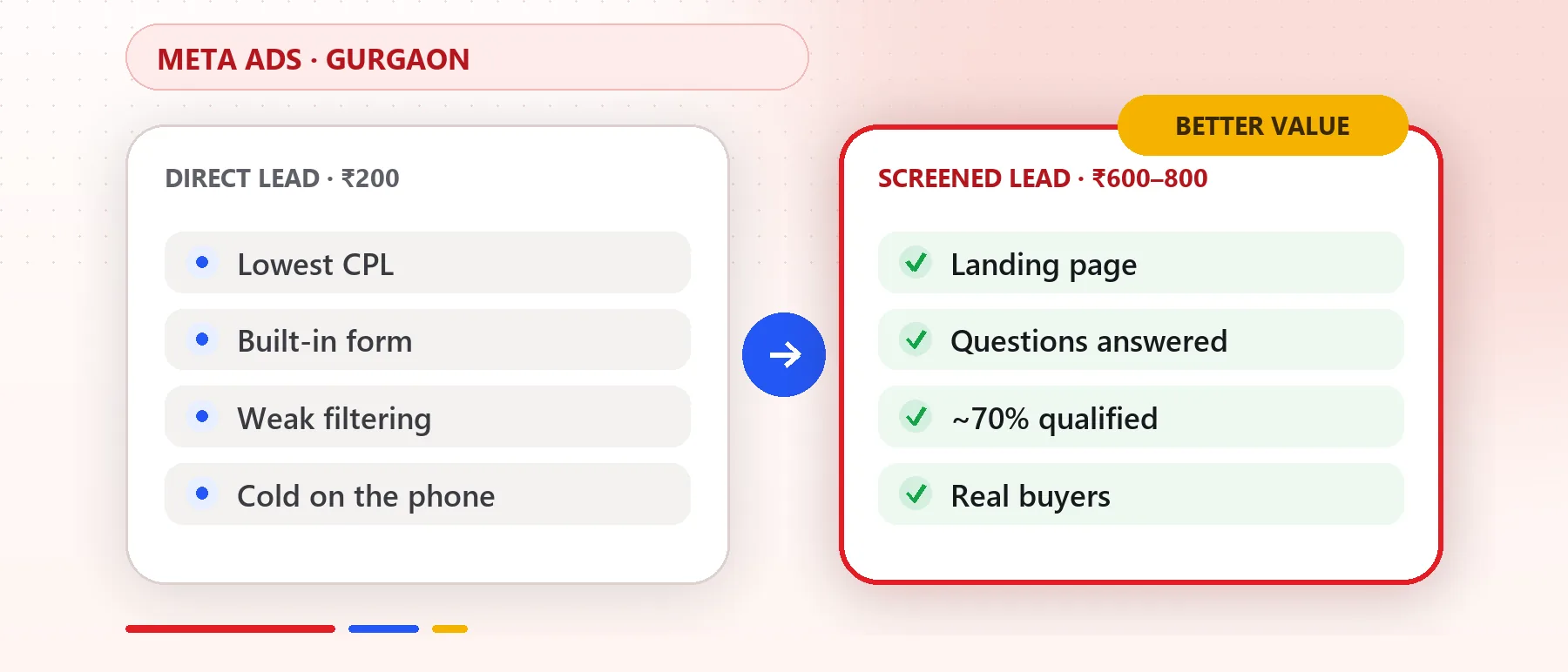
| ₹50 L–1 Cr (Entry) | ₹200 | ₹600–800 |
| ₹1–2.5 Cr (Core) | ₹350–450 | ₹800–900 |
| ₹2.5–4 Cr (Premium) | ₹500–600 | ₹1,000–1,100 |
| ₹5–10 Cr (Luxury) | ₹700–900 | ₹1,300–1,700 |
| ₹10–20 Cr (Ultra) | ₹1,200–1,800 | ₹2,200–2,700 |
A screened lead costs more because the buyer has already answered your qualification questions on a landing page. In the entry band, about 70% of screened leads are qualified before they reach your team. That works out to roughly ₹860–1,140 per qualified lead, against ₹200 for a direct lead. The direct lead only wins if at least one in five of them is a real buyer.
The five levers that actually lower cost per qualified lead
Lever 1: Choose how broad your audience should be
Broadening the audience lowers CPL, and sometimes that is the right call. A good approach is to run both:
- A focused audience for high-intent buyers (location, income signals, behaviour, interests), which costs more per lead but gives better buyers.
- A broader audience to let Meta’s system find buyers you did not think of, which lowers cost but needs stricter filtering on the landing page.
The rule: the broader you go, the stronger your qualification must be. Widening the audience without a filter simply floods your team with weak leads.
Lever 2: Send traffic to a landing page or self-hosted form
This is one of the most practical improvements you can make. Instead of relying only on Meta’s built-in lead form, send people to a landing page or a form hosted on your own website or server.
Why it works:
- You control everything in the back end. You can change questions, fields, thank-you pages, routing and follow-up without touching the ads. Significant edits to a running ad can reset Meta’s learning, so keeping changes on your own page protects performance.
- It filters buyers. Asking budget, size, purpose and timeline before submission means the people who finish are more serious.
- It improves tracking. You can fire the right conversion events and pass lead quality back to Meta.
- It builds your own data. Leads land directly in your CRM, ready for instant WhatsApp follow-up.
The trade-off. A landing page usually costs more per lead than a built-in form, because it adds a step. That is exactly the point. In our experience, a smaller number of better leads beats a bigger number of weak ones.
Lever 3: Build lookalike audiences from real buyer data
Lookalike audiences ask Meta to find people who resemble a list you provide. The quality of the list decides the quality of the audience.
- Weak seed: every raw lead. This copies your low-quality leads.
- Better seed: qualified leads.
- Best seed: site visitors and actual buyers.
Even a small list of past buyers or serious site visitors can outperform a large list of raw enquiries. Refresh your seed lists regularly as new qualified leads and buyers come in.
Lever 4: Use retargeting to bring back warm buyers
Retargeting shows ads to people who already showed interest. For high-ticket property, most buyers need several touches before they act. Useful retargeting groups include:
- Landing page visitors who did not submit the form.
- People who started the form but did not finish.
- Video viewers who watched most of a project video.
- People who engaged with your Instagram or Facebook page.
- Old leads who never converted (where consent allows).
Retargeting audiences are small, so their CPL can be lower and their intent higher. Use fresh messages for them, such as an invitation to a site visit, a payment plan explainer or a construction update, instead of repeating the first ad.
Lever 5: Make the creative do the filtering
On Meta, creative acts as targeting. The words and images in your ad decide who stops scrolling, so use them to attract the right buyers and repel the wrong ones:
- State the price range or ticket size so people who cannot afford it do not click.
- Name the micro-market (Golf Course Road, Golf Course Extension Road, Dwarka Expressway), because location is a major buying filter.
- Show real proof: actual project visuals, site progress, layouts and a clear RERA registration number.
- Use formats that explain: short videos, carousels with floor plans and walk-throughs usually outperform a single static poster.
- Rotate creatives. Even strong ads tire out. Watch for rising CPL and falling click-through, and refresh before performance collapses.
Always keep ads within Meta’s advertising policies and within RERA rules. Confirm current HRERA advertising requirements with your legal advisor.
Micro-market playbook: what to emphasise where
Different corridors attract different buyers, so the same ad should not run everywhere.
- Golf Course Road: an established luxury address. Buyers are typically high-net-worth and used to premium choices. Expect higher CPL, and lead with exclusivity, community, build quality and location proof.
- Golf Course Extension Road: premium, with a heavy launch pipeline. Differentiation matters most here, so lead with what makes your project different: layouts, amenities, developer track record and delivery timeline.
- Dwarka Expressway: a wide range of ticket sizes and a mix of investors and end-users. Segment the audience and the message carefully, and use connectivity, price-growth context and possession timelines.
Tracking: teach Meta what a good lead looks like
If Meta only sees “someone submitted a form”, it will find more people who submit forms, whether or not they are buyers. To improve quality:
- Set up the Meta Pixel and Conversions API so events are tracked reliably.
- Track different events for a form view, a form submission and a qualified lead (someone who completed your qualification questions).
- Where possible, optimise toward the qualified-lead event, not raw submissions.
- Send CRM outcomes (site visit booked, visit completed) back where feasible, so the platform learns which leads were valuable.
This takes setup effort, but it is one of the strongest long-term ways to reduce cost per qualified lead.
Budget: what you need before CPL stabilises
Meta needs enough data to learn, and closures need enough lead volume. In our experience, this is the monthly ad budget typically needed to aim at the closures shown:
| Property ticket size | Closures to aim for | Typical monthly ad budget |
|---|---|---|
| Under ₹50 lakh | 5–10 | ₹1–1.3 lakh |
| ₹50 lakh–₹1 Cr | 3–4 | About ₹1.5 lakh |
| ₹1–2.5 Cr | 2–3 | ₹1.5–2 lakh |
| ₹2.5–5 Cr | 1–2 | ₹1.5–2 lakh |
| ₹5–10 Cr | 1–2 | ₹2–3 lakh |
| ₹10–20 Cr | 1–2 | ₹3–4 lakh |
| ₹20 Cr and above | 1–2 | About ₹5 lakh |
These are ad budgets, separate from agency fees. They are indicative, not guarantees. Closures also depend on pricing, inventory and your sales follow-up.
A practical rule: avoid changing budgets, audiences and creatives every day. Let a campaign run long enough to gather meaningful data, then make one change at a time.
Follow-up speed: the cheapest CPL fix you are ignoring
A lead you do not reach is a wasted lead, whatever it cost. Buyers enquire on several projects at once, and the first useful reply often wins.
- Send an instant WhatsApp message that mentions the project they asked about.
- Ask a qualifying question or two conversationally.
- Offer real site-visit slots and send reminders.
- Hand over to a human when the buyer wants to discuss price or visit.
Automation and AI can handle the first reply at any hour. This lifts the value of every lead you already pay for, which lowers your effective cost per qualified lead without touching the ad. See how our RDA™ system connects ads and follow-up, and read our guides to fixing junk leads and real estate lead generation in Gurgaon.
A 30-day testing plan
| Week | Focus | What to do |
|---|---|---|
| Week 1 | Setup | Build the landing page or self-hosted form, install Pixel and Conversions API, set up WhatsApp follow-up, create 3–4 creatives |
| Week 2 | Launch | Run a focused audience and a broad audience side by side, with a retargeting campaign for page visitors |
| Week 3 | Learn | Compare cost per qualified lead, not just CPL. Pause weak creatives, keep strong ones, start a lookalike from qualified leads |
| Week 4 | Scale | Increase budget on what produced site visits, refresh creatives, update seed lists and review sales feedback |
Common mistakes that keep CPL high
- Judging only by CPL. Cheap leads that do not answer the phone cost more in the end.
- Going broad with no filter. Wide audiences need strong qualification.
- Relying only on built-in forms. You lose control and quality.
- Seeding lookalikes with weak data. Raw leads create raw audiences.
- Never rotating creatives. Fatigue quietly raises cost.
- Editing too often. Constant changes can reset learning and hide what actually works.
- Slow follow-up. Hours of delay erase the value of the lead.
FAQ
Why is my Meta ads CPL so high for Gurgaon real estate?
Common causes are targeting expensive HNI audiences, crowded corridors with many competing projects, generic creative, tired ads, weak tracking and a weak landing page. Reaching wealthier buyers is naturally costlier on Meta.
How can I lower CPL on Meta ads for real estate?
You can broaden the audience, which lowers cost but usually lowers lead quality. A better approach is to improve creative, use a landing page or self-hosted form, build lookalike and retargeting audiences from real buyer data, track qualified-lead events and follow up faster.
What is a good CPL for Gurgaon real estate on Meta?
It depends on ticket size and lead type. In our experience, Meta CPL in India is around ₹200–400 for ₹2 Cr inventory, about ₹800 for ₹5 Cr and ₹1,500–2,000 for ₹10 Cr and above. These are indicative ranges, not guarantees.
Is a landing page better than a Meta lead form?
A landing page usually costs more per lead but gives better qualification, control and tracking. A Meta lead form gives more volume at lower cost but with weaker quality. Many developers use both.
Do lookalike audiences work for real estate?
They can work well when built from quality data such as qualified leads, site visitors or buyers. Lookalikes built from every raw lead tend to copy low-quality leads.
How much should I spend on Meta ads for a Gurgaon project?
It depends on ticket size. In our experience, roughly ₹1–1.3 lakh a month for inventory under ₹50 lakh, ₹1.5–2 lakh for ₹1–5 Cr, ₹2–3 lakh for ₹5–10 Cr, ₹3–4 lakh for ₹10–20 Cr and about ₹5 lakh above ₹20 Cr. These are ad budgets, excluding agency fees.
Sources
- The Tribune: Gurugram drives NCR price surge even as home sales dip, new launches slow
- Outlook Money: Gurugram’s luxury housing map expands beyond established strongholds
- Business Today: Golf Course Extension Road gets Rs 35,000 crore luxury housing push
If you want a stronger system behind your marketing
If you have a budget of ₹50,000 to ₹1.5 lakh a month for an agency, and you want a premium team that works on ads, AI follow-up and content together, connect with Grand Business Media. We work with realtors and developers who want clear process and honest reporting.
More from the GBM blog
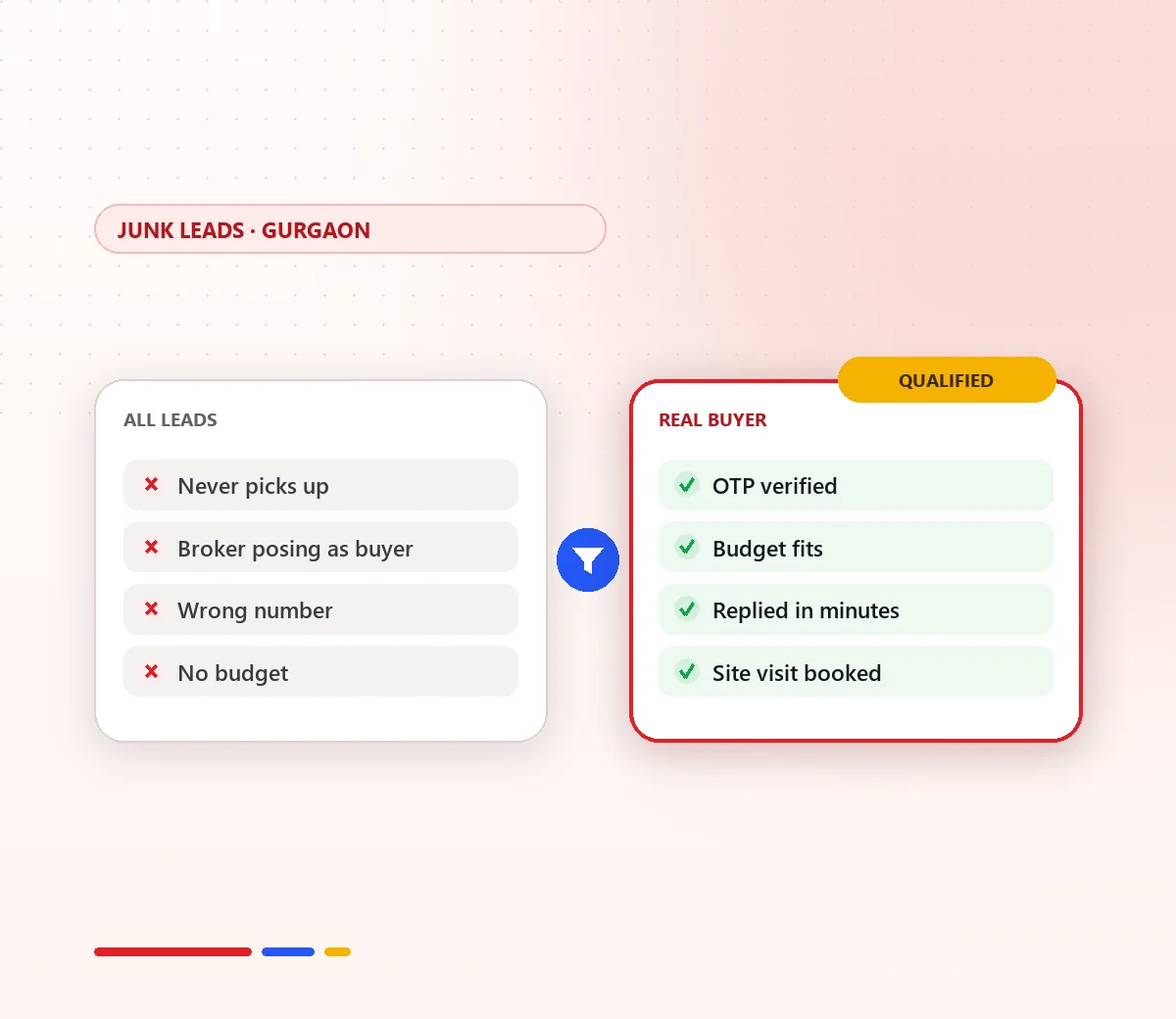
Why Your Real Estate Ads Bring Junk Leads in Gurgaon, and How to Fix Meta and Google Campaigns
Why Gurgaon developers get junk leads from Meta and Google ads, and the fixes: fast response, 100-touch follow-up, Meta targeting, retargeting, Google setup and tracking.
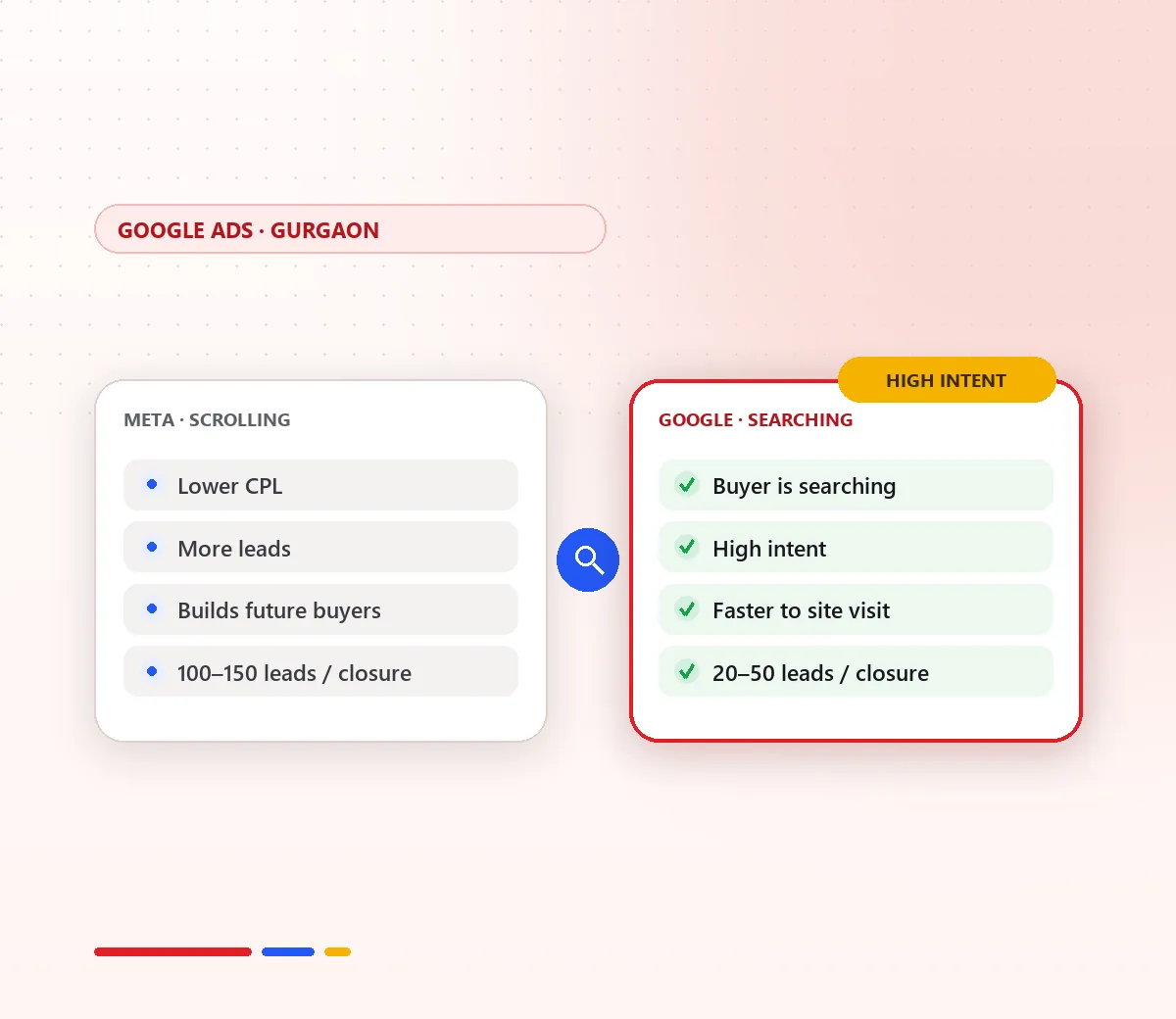
Google Ads for Real Estate in Gurgaon: How Developers Capture High-Intent Buyers
How Gurgaon developers use Google Ads to capture buyers already searching: keywords, ads, landing pages, tracking, CPL and budgets by ticket size.
Reading is step one. Let’s build your buyer pipeline.
Book a free 30-minute strategy session and we’ll map exactly how these systems would work for your projects.
Gurgaon · Dubai · Limited client seats each year